
Building a new future abroad as a married couple can be an exciting goal. Many couples dream about living together in another country finding better career opportunities creating a stable home and giving their family a new start.
But moving abroad as a couple requires more than simply choosing a country and booking a flight. The couple needs to the understand the correct visa route relationship requirements financial conditions documents language requirements and the rights that come with the visa.
In 2026 there are several immigration pathways available for couples depending on the their circumstances. Some countries have dedicated spouse or partner visas while others allow family members to join a person who already has a work study or residence permit.
This complete guide explains how couples can plan their move abroad in 2026 what documents they may need how spouse and family visas work and what couples should consider before starting an application.
What Does Building a New Future Abroad Mean for Couples?
Building a future abroad usually means that one or both partners plan to establish their life in another country.
One partner may already be living abroad as a citizen permanent resident skilled worker or student. In another situation both partners may be planning to move together through a family immigration or work-based pathway.
The correct visa depends on the couple’s circumstances.
For example a spouse of a Canadian citizen may use Canada’s family sponsorship system while the spouse of an Australian citizen or permanent resident can potentially use an Australian Partner visa pathway. The UK has a family visa route for eligible spouses and partners. Germany also provides family reunification routes for eligible family members.
Because every immigration system has different rules couples should always identify their exact immigration category before preparing an application.
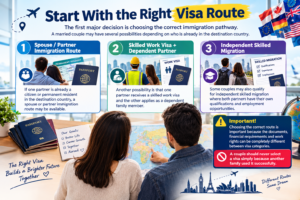
Start With the Right Visa Route
The first major decision is choosing the correct immigration pathway.
A married couple may have several possibilities depending on who is already in the destination country.
One partner may already be a citizen or permanent resident. In this case a spouse or partner immigration route may be available.
Another possibility is that one partner receives a skilled work visa and the other applies as a dependent family member.
Some couples may also qualify for independent skilled migration where both partners have their own qualifications and employment opportunities.
Choosing the correct route is important because the documents financial requirements and work rights can be completely different between visa categories.
A couple should never select a visa simply because another family used it successfully.
Genuine Relationship Is Important
Most spouse and partner immigration systems require evidence that the relationship is genuine.
Marriage alone may not be the only information requested by immigration authorities. Depending on the country and visa category applicants may need to demonstrate their shared history and relationship.
Useful evidence can include:
Marriage certificate Wedding photographs Travel records Joint bank accounts Joint bills Rental agreements Communication records Evidence of the living together Shared financial responsibilities Evidence of visits Birth certificates of the children if applicable
The exact evidence depends on the country.
For example Canada’s family sponsorship rules state that a sponsored spouse must be legally married to the sponsor and that the relationship must be genuine rather than entered into mainly to obtain permanent resident status.
The UK also asks spouse and partner applicants to provide evidence of their relationship. This can include marriage documents evidence of living together and evidence of shared expenses or an ongoing relationship when the couple does not live together.
Couples should therefore keep genuine relationship documents organized from the beginning.
Financial Planning Before Moving Abroad
Money is one of the most important parts of preparing for life abroad.
Even when a visa does not have a simple minimum income requirement the couple may still need money for accommodation food transportation health costs application fees travel and the first few months of living expenses.
Some countries have specific financial requirements.
For example UK partner and spouse applicants usually need to show combined income of at least £29,000 per year under the current family visa rules. Certain exceptions and transitional rules can apply.
Canada is different. In most cases there is no minimum necessary income requirement when sponsoring a spouse or partner although specific exceptions apply and Quebec has separate requirements.
This shows why couples should not copy financial figures from another country’s visa guide.
Before applying calculate:
Visa application costs Travel costs Accommodation deposit Monthly rent Food expenses Transportation Health insurance or healthcare costs Emergency savings Children’s expenses if applicable Job search period Document and translation costs
A realistic financial plan can make the transition much easier.
United Kingdom Spouse Visa 2026
The UK is one of the countries commonly considered by married couples planning to live together abroad.
The UK family visa route allows an eligible spouse or partner to join a person who is a British or Irish citizen or who has certain qualifying immigration status in the UK. Both partners generally need to be 18 or over and the couple must intend to live together permanently in the UK.
Applicants normally need to demonstrate their relationship and meet English language and financial requirements.
For most new partner applications the combined income requirement is currently £29,000 per year. Some applicants may qualify under different rules because of specific circumstances or transitional provisions.
Applicants should also prepare relationship evidence such as a marriage certificate photographs joint financial records accommodation documents and other evidence relevant to their circumstances.
For applications made outside the UK the current standard decision time is usually 12 weeks. Applications inside the UK can have different processing times depending on the circumstances and whether the financial and English requirements are met.
The UK family visa partner route can eventually lead to settlement for eligible applicants. The current guidance states that the earliest application for indefinite leave to remain on the five-year partner route is after five years of continuous residence on a family visa as a partner.
Canada Spouse Sponsorship 2026
Canada has a dedicated family sponsorship system for eligible spouses partners and dependent children.
A Canadian citizen permanent resident or person registered under the Canadian Indian Act may be able to sponsor a spouse or partner if the sponsorship requirements are met.
The sponsor generally must be at least 18 and live in Canada. A Canadian citizen living outside Canada can sponsor if they demonstrate plans to live in Canada when the sponsored person becomes a permanent resident. A permanent resident living outside Canada cannot sponsor under the standard rules.
The sponsored spouse must generally be at least 18 legally married to the sponsor and in a genuine relationship.
Canada’s family sponsorship system also includes common-law and conjugal partner categories with different eligibility requirements.
Most spouse sponsorship cases do not have a minimum income requirement. However there are exceptions involving certain dependent children and Quebec has additional requirements.
The application process involves both the sponsorship application and the permanent residence application. Canada currently allows eligible applicants to submit these applications together online through the Permanent Residence Portal.
Couples should also declare all family members as required even if some family members are not accompanying the principal applicant.
Australia Partner Visa 2026
Australia provides several partner visa options for eligible spouses and de facto partners of Australian citizens permanent residents and eligible New Zealand citizens.
The Partner visa system includes temporary and permanent stages.
For applicants outside Australia the Partner visa subclass 309 can allow an eligible spouse or de facto partner to move to Australia temporarily. The subclass 100 is the permanent stage.
For applicants already in Australia the subclass 820 is the temporary Partner visa and subclass 801 is the permanent stage.
Australia also has the Prospective Marriage visa subclass 300 for an eligible person planning to marry their prospective spouse in Australia before applying for a Partner visa.
The exact requirements depend on the relationship and visa category.
Couples should therefore check whether they are applying from inside or outside Australia before deciding which route applies.
Germany Family Reunification
Germany is another destination where family reunification can allow eligible spouses to live together.
The exact requirements depend heavily on the immigration status of the spouse already living in Germany.
For example the rules can differ when the sponsor is a German citizen compared with a foreign national holding a residence permit or an EU Blue Card.
Depending on the case the applicant may need to provide proof of marriage financial information accommodation documents identity documents and potentially German language evidence.
Some categories have exceptions from language requirements so couples should check the exact family reunification category instead of assuming that every spouse needs the same language qualification.
For couples moving to Germany it is also important to check the sponsor’s residence status before starting the application.
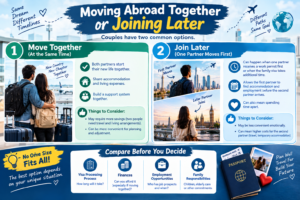
Moving Abroad Together or Joining Later
Couples have two common options.
The first is to move together at the same time.
This can be convenient because both partners can start their new life together and share accommodation and living expenses.
The second option is the for one partner to move first and the other partner to join later.
This can happen when one partner receives a work permit first or when the family visa application takes additional time.
Neither approach is automatically suitable for every couple.
Moving together may require more savings because two people need travel and living arrangements at the same time.
Moving separately can allow the first partner to find accommodation and employment before the second partner arrives but it can also mean spending time apart.
The couple should compare the visa processing process finances employment opportunities and family responsibilities before deciding.
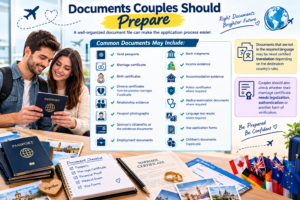
Documents Couples Should Prepare
A well-organized document file can make the application process easier.
Common documents may include:
Valid passports Marriage certificate Birth certificates Divorce certificates from the previous marriages if applicable Relationship evidence Passport photographs Sponsor’s citizenship or the residence documents Employment documents Bank statements Income evidence Accommodation evidence Police certificates where required Medical examination documents where required Language test results where required Visa application forms Children’s documents if applicable
Documents that are not in the required language may be the need certified translation depending on the destination country’s rules.
Couples should also check whether their marriage certificate needs legalization authentication or another form of verification.
Build a Strong Relationship Evidence File
A useful approach is to create a timeline of the relationship.
For example:
2019: First meeting
2021: Relationship started
2023: Engagement
2024: Marriage
2025: Joint travel and the family events
2026: Visa application
The dates above are only an example.
The real timeline should contain genuine events from the couple’s relationship.
Supporting documents can then be organized according to the timeline.
This can make it easier to the understand how the relationship developed.
The goal is not to create artificial evidence. Couples should provide genuine documents that the accurately represent their relationship.
Language Requirements
Language requirements vary between countries and visa categories.
The UK family visa route normally includes an English language requirement for eligible applicants.
Germany can have German language requirements for some family reunification cases but exemptions can apply depending on the sponsor and immigration category.
Canada’s spouse sponsorship system does not work in the same way as a general language-based skilled migration program.
Australia’s partner visa requirements are also different from many skilled work visa categories.
Therefore couples should always check the language requirement for the exact visa they are applying for.
Employment After Moving Abroad
One of the biggest questions for couples is whether both partners can work after moving.
The answer depends on the visa.
A family or partner visa may provide work rights while some temporary visas may have restrictions.
For example UK family visa applicants who are granted permission as a spouse or partner generally have work rights under that route. A fiancé or fiancée family visa is different because the applicant cannot work or study during the engagement period before switching after marriage.
Australia and Canada also have different rules depending on the specific visa and stage of the application.
Before accepting a job couples should check the work conditions attached to the actual visa grant.
Planning a Home in the New Country
Visa approval is only the beginning of building a future abroad.
Couples should also plan where they will live.
Before traveling research:
Average rent Deposit requirements Public transport Grocery costs Healthcare Local employment Schools if children are involved Banking Mobile services Local laws Weather Community support
It is useful to prepare temporary accommodation before arrival if permanent housing has not yet been arranged.
The couple should also keep enough emergency funds for unexpected expenses.
Planning for Children
Couples with children need additional planning.
Children may need separate applications or may be included as dependants depending on the immigration route.
Birth certificates and custody documents can become particularly important where children are involved.
Canada’s family sponsorship guidance requires applicants to declare family members including those who are not accompanying the applicant and may require them to undergo the applicable examination process.
Parents should therefore review the rules for every family member before submitting an application.
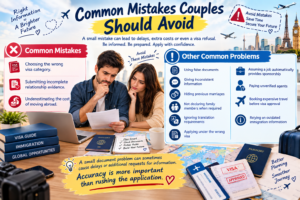
Common Mistakes Couples Should Avoid
One common mistake is choosing the wrong visa category.
Another is submitting incomplete relationship evidence.
Some couples also underestimate the cost of moving abroad.
Other problems can include:
Using false documents Giving inconsistent information Hiding previous marriages Not declaring family members when required Ignoring translation requirements Applying under the wrong visa Assuming a job automatically provides sponsorship Paying unverified agents Booking expensive travel before visa approval Relying on outdated immigration information
A small document problem can sometimes cause delays or additional requests for information.
Accuracy should therefore be more important than rushing the application.
Avoid Fake Visa and Sponsorship Offers
Couples planning to move abroad should be especially careful with online visa advertisements.
Some websites and social media pages may advertise guaranteed spouse visas guaranteed jobs or guaranteed immigration approval.
No legitimate private person can guarantee an immigration decision.
Be careful if someone asks for a large payment before explaining the employer visa category or official application process.
Always verify the immigration information through the official government website for the country involved.
If professional immigration assistance is required use a properly authorized professional where applicable.
A Simple 2026 Roadmap for Couples
A practical plan can make the process easier.
Step-by-Step Relocation Process
Step 1: Choose the Destination
Compare countries based on immigration eligibility employment family rights cost of living and long-term plans.
Step 2: Identify the Visa Route
Decide whether you need a spouse visa family reunification visa dependent visa skilled work visa or another immigration pathway.
Step 3: Check Eligibility
Review age relationship sponsor status financial requirements language requirements and other conditions.
Step 4: Collect Documents
Prepare passports marriage certificates relationship evidence financial records and the other required documents.
Step 5: Prepare Your Finances
Calculate application fees travel costs accommodation and several months of the living expenses.
Step 6: Complete Required Tests
Arrange language tests medical examinations police certificates or other required checks where applicable.
Step 7: Submit the Application
Complete the official forms carefully and the upload the required evidence.
Step 8: Complete Biometrics or Interview
If required attend the relevant biometric appointment or interview.
Step 9: Wait for the Decision
Processing times vary by country visa type application volume and individual circumstances.
Step 10: Prepare for the Move
Once the visa is approved arrange travel accommodation banking employment planning and other practical matters.
Quick Eligibility Checklist for Couples
Before starting a spouse or partner visa application ask these questions:
Are both partners old enough under the relevant visa rules? Is the marriage or partnership legally recognized? Is the relationship genuine? Does the sponsoring partner have the required citizenship or residence status? Can the couple meet the financial requirements if applicable? Is a language test required? Are passports valid? Are marriage and civil documents available? Are previous marriages properly documented? Are children and other family members correctly declared? Are medical and police checks required? Is the selected visa suitable for the couple’s actual circumstances?
Meeting a basic checklist does not guarantee visa approval. Immigration authorities assess applications under the rules that apply to the specific country and visa category.
Final Thoughts
Couples Building a New Future Abroad in 2026 can turn a long-term dream into a structured immigration plan when the couple understands the process before applying.
The most important step is choosing the correct immigration route.
The UK family visa system has specific relationship financial and English requirements. Canada provides a dedicated family sponsorship pathway for the eligible spouses and partners. Australia has several Partner visa options for eligible spouses and de facto partners. Germany provides family reunification pathways that the depend on the sponsor’s status and the applicant’s circumstances.
Every couple has a different situation.
A successful plan should therefore be based on genuine relationship evidence accurate documents realistic financial preparation and the current immigration rules of the chosen country.
Moving abroad is not only about receiving a visa. It is also about preparing for a new home new responsibilities employment healthcare accommodation and long-term family goals.
With careful preparation couples can approach their 2026 immigration journey with a clear understanding of what they need to do and what they should expect at each stage.