
Moving to Canada after marriage can be an exciting new chapter for couples who want the build their future together. For many married couples the Canadian family sponsorship system provides a pathway for a husband or wife to become a permanent resident and join their spouse in Canada.
The process is not simply about having a marriage certificate. The sponsor and the sponsored spouse must both meet the applicable immigration requirements. The relationship must be genuine and the application must include the required forms documents and the supporting evidence.
This complete guide explains Canada spouse sponsorship and the family reunification in the 2026. It covers who can sponsor a spouse how the application works documents financial requirements processing stages work options and practical steps for couples planning a new life in Canada.
What Is Canada Family Sponsorship?
Canada’s family sponsorship program allows eligible Canadian citizens and permanent residents to the sponsor certain family members for permanent residence.
A spouse can be sponsored when the marriage is legally valid and the relationship is genuine. The sponsored spouse must also the meet Canada’s admissibility requirements.
The program can be used when the spouse is living outside Canada or in certain circumstances when the spouse is already living in Canada with the sponsor.
The main goal is family reunification so the eligible couples can live together in Canada as permanent residents.
Who Can Sponsor a Spouse in Canada?
The sponsor must meet specific requirements.
Generally the sponsor must:
Be at least 18 years old Be a Canadian citizen or permanent resident or a person registered under the Canadian Indian Act Live in Canada Sign the required sponsorship undertaking and agreement Meet the other requirements under Canadian immigration law
A Canadian citizen who is living outside Canada may still be able to sponsor a spouse if they can demonstrate that they plan to live in Canada when the sponsored person becomes a permanent resident.
A permanent resident living outside Canada cannot sponsor a spouse.
This makes the sponsor’s current status and location important before starting the application.
Who Can Be Sponsored as a Spouse?
The person being sponsored must meet the requirements for a spouse under Canadian immigration rules.
For a married couple the spouse must be legally married to the sponsor and must generally be at least 18 years old.
The relationship must also be genuine and not entered into mainly for obtaining permanent resident status.
The applicant must also be admissible to Canada. This can involve medical security and background requirements depending on the circumstances.
A marriage certificate alone does not guarantee approval.
Genuine Marriage Requirement
One of the most important parts of a spouse sponsorship application is demonstrating that the relationship is genuine.
Canada expects the marriage or relationship to be real and the not created primarily for the immigration purposes.
Couples should therefore provide truthful evidence that reflects their actual relationship.
Depending on the circumstances evidence can include photographs from different occasions communication records travel documents evidence of visits wedding documents joint financial information and other records showing the history of the relationship.
The goal is not to submit hundreds of unnecessary documents. The goal is to provide clear and consistent evidence that explains how the relationship developed.
Couples should never create fake conversations photographs or documents.
Is There an Income Requirement for Sponsoring a Spouse?
For most spouse sponsorship applications there is no minimum income requirement for sponsoring a spouse or partner.
There are exceptions in specific family situations. For example an income requirement can apply when the sponsored spouse or partner has a dependent child and that child has one or more dependent children of their own.
Quebec also has its own sponsorship and income requirements.
This is an important difference from some other countries where spouse immigration normally has a fixed income threshold.
Even when there is no general minimum income requirement the sponsor signs an undertaking to provide financial support for the sponsored family member during the applicable undertaking period.
Sponsor’s Financial Responsibility
Sponsoring a spouse is a serious legal commitment.
The sponsor signs an undertaking agreeing to financially support the sponsored family member and make reasonable efforts to ensure that the person does not need social assistance.
If the sponsored person receives certain social assistance during the undertaking period the sponsor may be required to repay the amount to the government.
The undertaking continues even if the couple’s personal circumstances change.
For this reason a sponsor should understand the financial responsibility before submitting the application.
Canada Spouse Sponsorship From Outside Canada
If the spouse lives outside Canada the application will normally be processed under the Family Class.
This is commonly called outland spouse sponsorship.
For example a Canadian citizen living in Canada may sponsor a husband or wife who is living in Pakistan another country or another location outside Canada.
The sponsored spouse applies for permanent residence while the sponsorship application is processed.
The application is submitted online through Canada’s permanent residence system.
This route can be useful when the couple is living in different countries and the applicant is waiting to move to Canada permanently.
Spouse Sponsorship From Inside Canada
Canada also has a class for spouses or common-law partners who are already living in Canada with their sponsor.
This is commonly known as the Spouse or Common-Law Partner in Canada Class.
The applicant needs to meet the requirements of this class and maintain appropriate temporary status where required.
A spouse living in Canada may also be able to apply for an open work permit while the permanent residence application is being processed if the relevant conditions are met.
This can provide an option for couples who are already together in Canada.
Canada Spouse Sponsorship Application Process
The process has two connected parts.
The first part is the sponsorship application. The Canadian spouse applies to become the sponsor.
The second part is the permanent residence application for the spouse being sponsored.
IRCC explains that the principal applicant submits both applications together through the Permanent Residence Portal.
The couple must complete the required forms and upload the supporting documents listed in their application checklist.
The application should be reviewed carefully before submission because an incomplete application can be rejected and may need to be corrected and submitted again.
Documents Needed for Canada Spouse Sponsorship
The exact document checklist depends on the applicant’s circumstances and country of residence.
Common documents can include:
Valid passport Marriage certificate Birth certificates where required Sponsor’s proof of the Canadian citizenship or permanent residence Relationship evidence Photographs Police certificates where required Medical examination documents Required immigration forms Proof of previous marriages or divorces if applicable Country-specific documents Additional documents requested by the IRCC
The application system provides a personalised document checklist.
Applicants should follow that checklist rather than relying on an old document list found on social media or an unofficial website.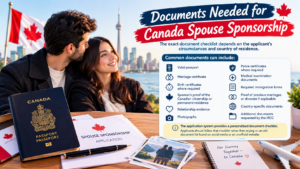
Marriage Certificate for Canada Immigration
The marriage certificate is a key document for married couples.
It should demonstrate that the marriage is legally recognised in the jurisdiction where it took place.
If the couple married outside Canada the document may need to meet Canada’s requirements for foreign civil documents.
Applicants should also make sure that names dates and other personal information are consistent across passports marriage certificates and other documents.
If there are differences such as spelling variations the couple should provide an appropriate explanation and supporting evidence where necessary.
Relationship Evidence
Relationship evidence can be particularly important when the couple has lived apart.
Examples may include photographs together records of visits travel documents communication records wedding photographs invitations joint financial arrangements and evidence of shared family activities.
The exact evidence depends on the couple.
A couple who has lived together for years may have different evidence from a couple who married recently and have spent much of their marriage in different countries.
The best approach is to provide genuine evidence that tells a clear and consistent story of the relationship.
Medical and Background Checks
The sponsored spouse and applicable family members must be meet the Canada’s admissibility requirements.
This can involve medical examinations and background or security checks.
IRCC states that the person being sponsored and their family members must pass the applicable background security and medical checks.
Applicants should follow the instructions they receive from IRCC regarding medical examinations and the police certificates.
Do not complete documents or the examinations based on outdated instructions without checking the current application requirements.
Canada Spouse Sponsorship Fees in 2026
Applicants need to pay the required immigration fees.
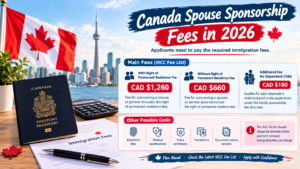
According to the current IRCC fee list the fee for sponsoring a spouse or partner is CAD $1,260 when the right of permanent residence fee is included.
The fee is CAD $660 when the right of permanent residence fee is not included.
An additional CAD $180 applies for each dependent child included in the application under the listed family sponsorship fee structure.
There can also be other costs such as biometrics medical examinations police certificates translations and document-related services.
The IRCC fee list should always be checked before payment because immigration fees can change.
Biometrics for Canada Spouse Sponsorship
Biometrics may be required as part of the immigration application.
IRCC currently lists the individual biometrics fee as CAD $85, while families applying at the same time have a maximum biometrics fee of CAD $170 under the applicable fee structure.
Applicants should follow the biometrics instructions they receive after submitting the application.
Can the Sponsored Spouse Work in Canada?
Work rights depend on where the spouse is living and which immigration status they currently have.
A person outside Canada cannot simply start working in Canada because a spouse sponsorship application has been submitted.
If the spouse is already living in Canada with the sponsor and meets the requirements of the applicable public policy they may be eligible to apply for an open work permit while their permanent residence application is being processed.
The spouse must wait for the work permit to be approved before starting work unless they already have valid work authorisation.
Therefore couples should not assume that submitting a sponsorship application automatically gives the applicant permission to work.
Can a Canadian Sponsor Living Abroad Sponsor a Spouse?
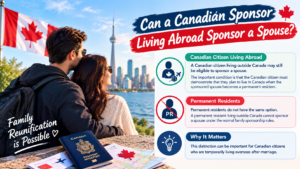
A Canadian citizen living outside Canada may still be eligible to sponsor a spouse.
The important condition is that the Canadian citizen must demonstrate that they plan to live in Canada when the sponsored spouse becomes a permanent resident.
Permanent residents do not have the same option. A permanent resident living outside Canada cannot sponsor a spouse under the normal family sponsorship rules.
This distinction can be important for Canadian citizens who are temporarily living overseas after marriage.
Canada Spouse Sponsorship for Permanent Residents
A permanent resident of Canada who lives in Canada can generally sponsor an eligible spouse if the other requirements are satisfied.
The sponsor must meet the eligibility rules and sign the required undertaking.
The sponsored spouse must complete the permanent residence process and satisfy the applicable admissibility requirements.
The relationship must also be genuine.
Permanent residence through spouse sponsorship is therefore a family immigration process rather than a temporary spouse visa.
What About Children?
If the couple has dependent children the children may be included in the permanent residence application when eligible.
The application requires applicants to declare their family members.
IRCC specifically states that applicants must declare all family members including those who are not accompanying them to Canada.
This is an important requirement because failing to declare a family member can create serious problems for future sponsorship.
Parents should therefore carefully review the family information section of the application.
Canada Family Sponsorship for Quebec
Quebec has different immigration arrangements from the other Canadian provinces and territories.
A sponsor living in Quebec must meet Quebec’s sponsorship requirements and may need to complete a separate undertaking with the Government of Quebec.
IRCC states that Quebec has its own eligibility and income requirements where applicable.
Couples living in Quebec should therefore follow the Quebec-specific instructions instead of using a standard federal process without checking the additional requirements.
How Long Does Canada Spouse Sponsorship Take?
Processing times can vary.
IRCC explains that processing time depends on factors such as the type of application whether the application is complete how quickly information can be verified the time taken by applicants to respond to requests and the number of applications being processed.
Because of these factors couples should not rely on a fixed processing time advertised by an agent or social media page.
The official IRCC processing-time system should be checked for the latest estimate relevant to the application.
A complete application can help avoid unnecessary delays caused by missing forms or documents.
Common Reasons Applications Can Face Problems
One common problem is an incomplete application.
Missing forms signatures payments or supporting documents can cause the application to be rejected or returned.
Another issue is inconsistent information.
For example the marriage date relationship history addresses or travel information should be truthful and consistent across the application and supporting evidence.
Weak or unclear relationship evidence can also create questions if the circumstances require additional proof.
Applicants should also avoid submitting fake documents.
False information can have serious immigration consequences.
How Couples Can Prepare Strongly
A good application starts with preparation.
The sponsor should first confirm eligibility to sponsor.
The couple should then confirm that the marriage qualifies under Canadian immigration rules.
After that they should collect the required civil documents and prepare evidence of their relationship.
The couple should carefully complete all forms and review the personalised checklist.
All documents should be clear readable and truthful.
If documents are not in an accepted language format the applicants should follow IRCC’s instructions for translation or certification.
Finally the application should be submitted through the official online process.
Simple Canada Spouse Visa Roadmap for 2026
Couples can use this simple roadmap when planning their move.
Step-by-Step Relocation Process
Step 1: Confirm that the sponsor is eligible.
Step 2: Confirm that the marriage meets Canada’s spouse requirements.
Step 3: Decide whether the application is being made under the Family Class or the Spouse or Common-Law Partner in Canada Class.
Step 4: Collect passports marriage certificates civil documents and relationship evidence.
Step 5: Complete the sponsorship and permanent residence forms.
Step 6: Follow the personalised document checklist.
Step 7: Pay the applicable government fees.
Step 8: Submit the application online.
Step 9: Complete biometrics and medical requirements when requested.
Step 10: Respond to IRCC requests for additional information.
Step 11: Track the application online.
Step 12: If approved complete the final permanent residence steps and prepare for life in Canada.
Preparing for Life Together in Canada
Receiving permanent residence is only one part of the journey.
Couples should also prepare for housing employment transportation healthcare banking and everyday living costs.
The spouse moving to Canada may need time to adjust to the Canadian climate workplace culture and local community.
Finding employment can also take time.
A person who has professional qualifications from another country may need to investigate Canadian recognition or licensing requirements depending on their occupation.
Learning English or French can also make daily life and employment easier.
Couples should create a realistic financial plan for the first few months after arrival.
What About Finding a Job After Arrival?
Spouse sponsorship itself is primarily an immigration pathway for permanent residence rather than a job sponsorship program.
Once the sponsored spouse becomes a permanent resident they can generally live and work in Canada subject to the rights and conditions of permanent residence.
Before that point work authorisation depends on the person’s temporary status and any applicable work permit.
Couples should therefore avoid advertisements that claim a spouse sponsorship application automatically includes a guaranteed Canadian job.
Employment opportunities depend on qualifications experience location and the Canadian labour market.
Avoid Fake Canada Visa and Sponsorship Offers
People looking for family immigration can sometimes encounter misleading offers online.
Be careful if the an agent or website promises guaranteed permanent residence.
You should also be cautious about the anyone who claims they can sell a guaranteed Canadian spouse sponsorship or the asks for money to create fake relationship evidence.
A legitimate application is based on the real relationship and genuine documents.
Canada’s official immigration system requires the applicant and sponsor to the provide accurate information and supporting documentation.
No private person can guarantee the final immigration decision.
Love Across Borders: Planning the Move Together
Moving to Canada as a married couple is more than completing an immigration application.
It is also about preparing for a new lifestyle.
Before the move couples can discuss where they want to live what type of work they will seek how they will manage expenses and how they will support each other during the adjustment period.
If children are involved they should also plan for schools healthcare housing and transportation.
Having these conversations before the move can make the transition easier.
Final Thoughts
Canada’s family sponsorship system gives eligible Canadian citizens and permanent residents a pathway to sponsor their spouses for permanent residence.
For most spouse sponsorship cases there is no general minimum income requirement although specific exceptions and Quebec rules apply. The sponsor must meet the eligibility requirements and sign an undertaking to support the sponsored family member.
The sponsored spouse must be legally married to the sponsor and the relationship must be genuine rather than created mainly for immigration purposes. The applicant must also meet the Canada’s admissibility requirements.
The application is submitted online and includes both the sponsorship and permanent residence components. Couples need to the provide the required forms the documents relationship evidence and other supporting information.
For couples living apart this process can be an important step toward building a shared future in Canada. Careful preparation honest documentation and the following the current IRCC instructions are essential.
Canada immigration requirements and the fees can change so couples should always check the latest official information before submitting an application.