
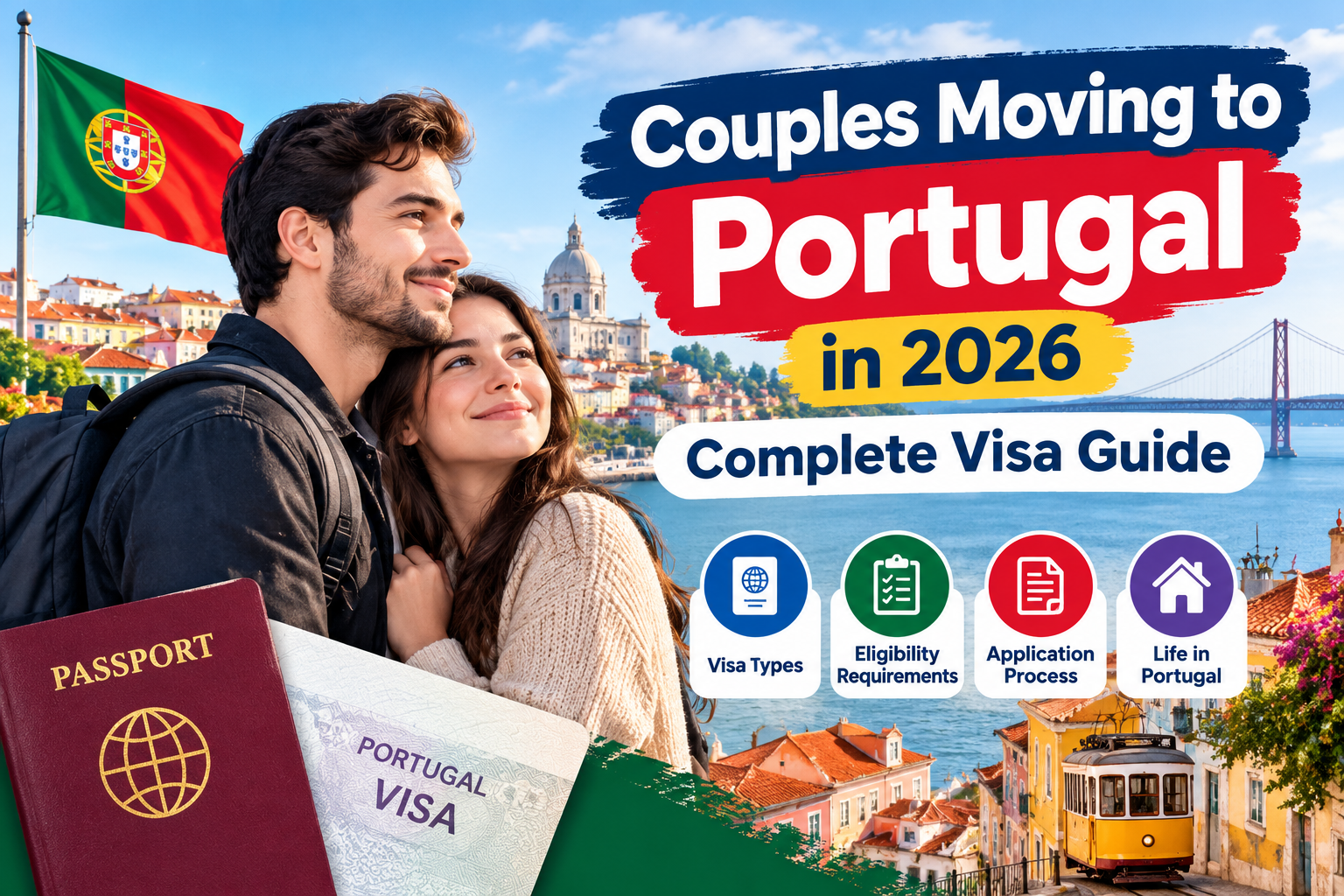
Moving to Portugal as a married couple can be an exciting opportunity for couples who want to build a new life in Europe. Portugal offers different residence pathways depending on employment family relationships remote work personal income and other circumstances.
For couples from outside the European Union European Economic Area and Switzerland the important point is that there is no single “couples visa” for everyone. The correct route depends on how the couple plans to qualify for residence.
One spouse may move to Portugal through employment while the other applies through family reunification. In another situation both partners may qualify independently through work or another residence route. A couple may also have one partner qualify through remote work while the other joins as a family member if the applicable requirements are met.
Portugal’s official immigration system is handled through different authorities including Portuguese consular services and the Agency for Integration Migration and Asylum known as AIMA. The exact procedure depends on the residence route.
This complete 2026 guide explains the main options for married couples moving to Portugal including family reunification work residence remote work personal income documents financial planning accommodation and the application process.
Can Married Couples Move to Portugal Together?
Yes. Married couples can potentially live in the Portugal together if they qualify under the appropriate immigration route.
The most important step is choosing the correct residence pathway before making travel plans.
Portugal’s family reunification system allows eligible family members of a foreign resident in Portugal to apply to join that resident. A spouse is specifically included among the eligible family members.
However couples do not necessarily have to use family reunification.
For example one spouse may receive a Portuguese residence visa based on employment. The other spouse can potentially use family reunification if the legal conditions are satisfied.
Alternatively both spouses could have their own independent residence basis if both qualify for separate visas.
Main Portugal Visa Options for Couples in 2026
The best route depends on your situation.
Family Reunification
Family reunification can be relevant when one spouse is already legally resident in Portugal and wants to bring their husband or wife to Portugal.
Portuguese authorities list a spouse as an eligible family member for family reunification. Other eligible family members can include certain children and dependent parents depending on the circumstances.
Employment Residence Visa
A spouse who has a genuine job opportunity in Portugal may apply for the appropriate residence visa for subordinate employment.
Portugal’s official government information confirms that non-EU/EEA/Swiss nationals who want to work in Portugal can apply for a residence visa for dependent employment.
This can be useful when one or both spouses have employment opportunities in Portugal.
Remote Work Residence Route
Portugal also has a residence route for people performing remote professional activities for entities or clients outside Portugal.
AIMA’s current information describes the residence permit for remote professional activity performed for an entity or person outside Portugal. The temporary residence permit is valid for two years from issuance and can be renewed for successive three-year periods.
This route can be relevant to couples who earn income remotely and meet the applicable requirements.
Residence Based on Own Income
Portugal also has a residence visa for retirees and people who live from their own income.
The official government service lists retirees and people living from their own income among those who may apply for this residence route. Applicants need to provide evidence of accommodation and means of subsistence among other documents.
The correct route depends on the applicant’s actual income source and circumstances.
Family Reunification for Married Couples
Family reunification is one of the most important options for couples when one spouse already has legal residence in Portugal.
The resident spouse normally starts the family reunification process with AIMA.
AIMA’s current requirements include proof of the resident’s residence permit the family member’s passport authenticated evidence of the family relationship proof of accommodation proof of means of subsistence and criminal-record documentation for the family member in relevant circumstances.
For married couples the marriage certificate is an important document.
AIMA specifically lists an authenticated marriage certificate as evidence of the marital relationship.
This means couples should make sure their marriage documents are properly prepared before beginning the process.
Can You Apply Together From Outside Portugal?
The answer depends on the immigration route.
If one spouse is applying independently for a Portuguese residence visa while the other is joining through family reunification the procedures may not be identical.
For family reunification involving a family member outside Portugal the resident in Portugal can request family reunification through AIMA. After approval the family member outside Portugal applies for the residence visa through the appropriate Portuguese consular post. After entering Portugal with the residence visa the family member then proceeds with the residence permit process through AIMA.
Because procedures can change it is important to check the Portuguese consulate responsible for the country where the applicants live.
Financial Requirements for Couples
Financial planning is an important part of a Portugal immigration application.
For family reunification AIMA’s means-of-subsistence framework uses percentages of the Portuguese minimum wage.
The current AIMA page explains the calculation as 100% of the minimum wage for the first adult 50% for a second or additional adult and 30% for each child under 18 or dependent adult child.
Portugal’s 2026 minimum monthly wage is €920. This was officially set from 1 January 2026.
Using those percentages as a basic reference means a household with two adults would use the applicable first-adult and second-adult amounts in the assessment.
However couples should not treat a simple percentage calculation as a guarantee of approval. The exact financial assessment depends on the residence route and the evidence submitted.
For other residence routes such as employment remote work or own-income residence there can be different financial and documentary requirements.
Accommodation Requirements
Couples should arrange suitable accommodation before completing the relevant residence process.
Proof of accommodation can be important for Portuguese immigration applications.
For family reunification AIMA asks the resident to provide a declaration concerning the address and evidence showing the legal basis for living in the property such as ownership or a rental arrangement.
This means couples should keep their rental agreement property documents or other acceptable evidence organized.
Do not rely on an informal arrangement that cannot be properly documented.
Documents Married Couples Should Prepare
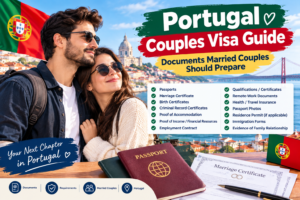
Although the exact document list depends on the visa route the following documents can commonly become important:
Valid passports Marriage certificate Birth certificates where required Criminal record certificates Proof of accommodation Proof of income or financial resources Employment contract where applicable Professional qualifications where required Remote-work employment or service documents where applicable Health or travel insurance where required Passport photographs Residence permit of the spouse already living in Portugal Immigration forms Evidence of family relationship Certified translations where required
Documents issued outside Portugal may need authentication or legalization depending on the document and country of issue.
AIMA states that foreign-language documents should be accompanied by an appropriate translation and provides information about accepted translation arrangements.
Couples should check the Portuguese consular authority responsible for their country before submitting documents.
Marriage Certificate for Portugal Immigration
The marriage certificate is one of the most important documents for a married couple.
If one spouse is applying through family reunification the authorities need evidence that the marriage is legally recognized.
AIMA specifically lists an authenticated marriage certificate for married applicants.
Make sure the names dates of birth and other information are consistent across passports and civil documents.
If there is a spelling difference or another discrepancy it is better to resolve the issue before submitting the immigration application.
Moving to Portugal Through Work
Employment can be another pathway for couples.
Portugal’s residence visa for dependent employment is available to eligible non-EU/EEA/Swiss nationals who intend to work in Portugal.
A worker should normally find a genuine employment opportunity and prepare the employment documents required for the application.
Possible employment sectors can include:
Information technology Engineering Construction Hospitality Tourism Healthcare Manufacturing Logistics Skilled trades Customer service Finance Professional services
The availability of jobs and the immigration requirements vary by occupation.
A couple should not assume that every Portuguese job comes with immigration sponsorship.
Can Both Spouses Work in Portugal?
The ability to work depends on the residence status and the conditions attached to the relevant permit.
A spouse who enters Portugal through a family residence route should check the conditions of the residence permit before starting employment.
Likewise a person holding a residence permit based on remote work must follow the conditions of that permit.
Do not start a job simply because you have entered Portugal as a visitor or because your spouse has received a residence permit.
Your own immigration status determines what activities you are legally allowed to perform.
Portugal Remote Work Route for Couples
Remote work can be an attractive option for couples who already earn money from companies or clients outside Portugal.
AIMA’s current information confirms a residence permit route for professional activity performed remotely for persons or entities outside Portugal.
The applicant needs to provide evidence related to the remote professional relationship and accommodation among other requirements.
The residence permit under this route is currently described by AIMA as valid for two years and renewable for successive three-year periods.
Couples considering this route should carefully verify the current income threshold and supporting-document requirements with the competent Portuguese authorities before applying.
Portugal Residence for People With Their Own Income
Some couples may not need a Portuguese employer if they have qualifying independent financial resources.
Portugal has a residence visa route for retirees and people living from their own income.
The official government service requires evidence of accommodation and means of subsistence along with other documentation. The listed service fee is €90 and the stated processing period on that government page is 60 days.
This route can be relevant to people receiving pensions or qualifying regular income.
Applicants should verify the current financial requirements with the Portuguese consulate because financial rules and administrative procedures can change.
Portugal Family Reunification and Children
If a married couple has children the family situation should be considered before submitting the application.
Portugal’s family reunification rules can cover certain minor or dependent children depending on the circumstances.
AIMA lists children who are minors or incapacitated and dependent on the couple or one of the spouses among the family members who may qualify. Certain adult children can also qualify in specific circumstances such as being dependent unmarried students.
Parents should prepare birth certificates and other evidence required for each child.
If a child is travelling with only one parent additional consent or custody documentation may also be necessary depending on the circumstances.
Portugal Visa Process for Couples
A practical immigration roadmap can look like this.
Step 1: Decide How You Will Qualify
First determine whether your route will be:
Family reunification Employment Remote work Own income Another applicable residence category
Do not select a visa simply because another couple used it.
Step 2: Check Eligibility
Review the official requirements for your specific residence category.
Check income accommodation employment relationship and document requirements.
Step 3: Prepare Civil Documents
Collect passports marriage certificates birth certificates and other required civil records.
Make sure documents are properly authenticated or legalized where required.
Step 4: Prepare Financial Evidence
Organize employment records bank statements pension evidence income records or other documents relevant to your residence route.
Step 5: Arrange Accommodation
Prepare acceptable evidence showing where you intend to live in Portugal.
Step 6: Submit the Application
Residence visa applications from outside Portugal are generally handled through the appropriate Portuguese consular post.
For family reunification the resident spouse may first need to complete the applicable AIMA procedure.
Step 7: Complete the Residence Process
After entering Portugal with the appropriate residence visa the applicant may need to complete the residence permit process with AIMA.
Step 8: Settle in Portugal
After receiving the appropriate residence status the couple can begin arranging long-term accommodation employment education healthcare banking and other practical matters.
How Much Money Should Couples Save Before Moving?
Immigration requirements are only one part of the financial picture.
A couple should also budget for:
Visa fees Residence permit fees Document legalization Certified translations Flights Temporary accommodation Rental deposit Monthly rent Utilities Food Transportation Healthcare expenses Emergency savings School costs if applicable
Do not move with only the minimum amount needed for the application.
Unexpected expenses can occur during the first few months.
Having an emergency fund can give the couple more time to settle and search for suitable employment if needed.
Living Costs in Portugal
The cost of living depends heavily on the city.
Lisbon and some popular coastal areas can be significantly more expensive for accommodation than smaller cities and inland areas.
Couples should compare rent with expected household income before selecting a location.
A lower-rent city may have fewer employment opportunities while a larger city may offer more jobs but higher housing costs.
The best location therefore depends on the couple’s work situation rather than simply choosing the most popular destination.
Common Mistakes Couples Should Avoid
One of the biggest mistakes is assuming that a tourist stay can simply be converted into a long-term residence without following the correct rules.
Another mistake is choosing a visa route without understanding its requirements.
Couples should also avoid:
Fake employment contracts False bank statements Fake marriage documents Unverified immigration agents Guaranteed visa promises Paying large amounts to the unknown recruiters Using an incorrect visa category Ignoring document legalization requirements Forgetting to prepare children’s documents Underestimating accommodation costs Starting unauthorized employment
Portugal’s regulated labour-migration system emphasizes genuine employment contracts and the states that its labour-migration cooperation protocol does not create a new immigration route or reduce the legal requirements for visas.
Can Couples Buy Property in Portugal for a Visa?
Buying property should not automatically be treated as a residence-visa strategy.
Portugal’s residence system is the based on specific legal immigration categories and applicants need to qualify under the relevant route.
Therefore a couple should first identify an eligible residence pathway instead of assuming that purchasing a house will automatically provide a residence permit.
Property ownership and immigration status are separate matters.
Can Couples Eventually Apply for Permanent Residence?
Long-term residence planning should be considered from the beginning.
Temporary residence permits are different from permanent residence.
A couple should keep records of lawful residence renewals tax matters employment documents and other information that may be relevant to future residence applications.
The exact requirements for permanent residence or citizenship are separate from the initial visa requirements and can change over time.
Couples should therefore check the current official rules when they become eligible rather than relying on information from an old application.
Quick Eligibility Checklist for Couples
Before starting the Portugal immigration process ask yourself:
Are we legally married? Do we both have valid passports? Which spouse will be the main applicant? Which residence route are we using? Do we have the required financial evidence? Do we have suitable accommodation evidence? Is our marriage certificate properly authenticated? Are our documents translated where necessary? Do we have criminal record certificates where required? Does the main applicant have a genuine employment or qualifying income source if required? If using remote work do we meet the applicable remote-work requirements? If using family reunification does the resident spouse have the required Portuguese residence status? Have we prepared documents for our children if they are moving with us? Have we checked the current requirements with the Portuguese authorities?
This checklist can help organize the application but it does not guarantee visa approval.
Simple 2026 Portugal Moving Plan for Couples
A couple planning to move to Portugal can follow this basic roadmap:
First: Decide which spouse will qualify for residence.
Second: Select the correct visa or residence route.
Third: Check the current official requirements.
Fourth: Prepare passports civil documents financial records and accommodation evidence.
Fifth: Obtain a genuine job offer if using employment as the basis for residence.
Sixth: Prepare the family reunification documentation if one spouse will join the other.
Seventh: Submit the required application through the appropriate Portuguese authority.
Eighth: Complete the visa process before travelling where required.
Ninth: Enter Portugal using the appropriate residence visa.
Tenth: Complete the residence permit process with AIMA where required.
Eleventh: Arrange housing banking employment healthcare and other practical matters.
Twelfth: Maintain legal residence and keep all immigration documents up to date.
Final Thoughts
Moving to Portugal as a married couple in 2026 can involve several different immigration routes. The right option depends on your individual circumstances.
Family reunification can be relevant when one spouse already has legal residence in Portugal. Employment residence can work for applicants with qualifying Portuguese employment. Remote workers can explore the dedicated remote-work residence route while retirees and people living from qualifying personal income may have another residence option.
The most important part of the process is choosing the correct route and preparing genuine documents.
Couples should also plan beyond the visa itself. Housing costs employment healthcare family needs and emergency savings can have a major effect on the experience of moving abroad.
Portugal’s immigration procedures can change, so applicants should verify current requirements with the Portuguese consular authorities and AIMA before submitting an application.
With proper document preparation realistic financial planning and the correct immigration pathway a married couple can approach the Portugal relocation process in a much more organized way.