
San Antonio Manufacturing Jobs 2026: 3,000 New Positions Announced at a $200 Million Texas Plant
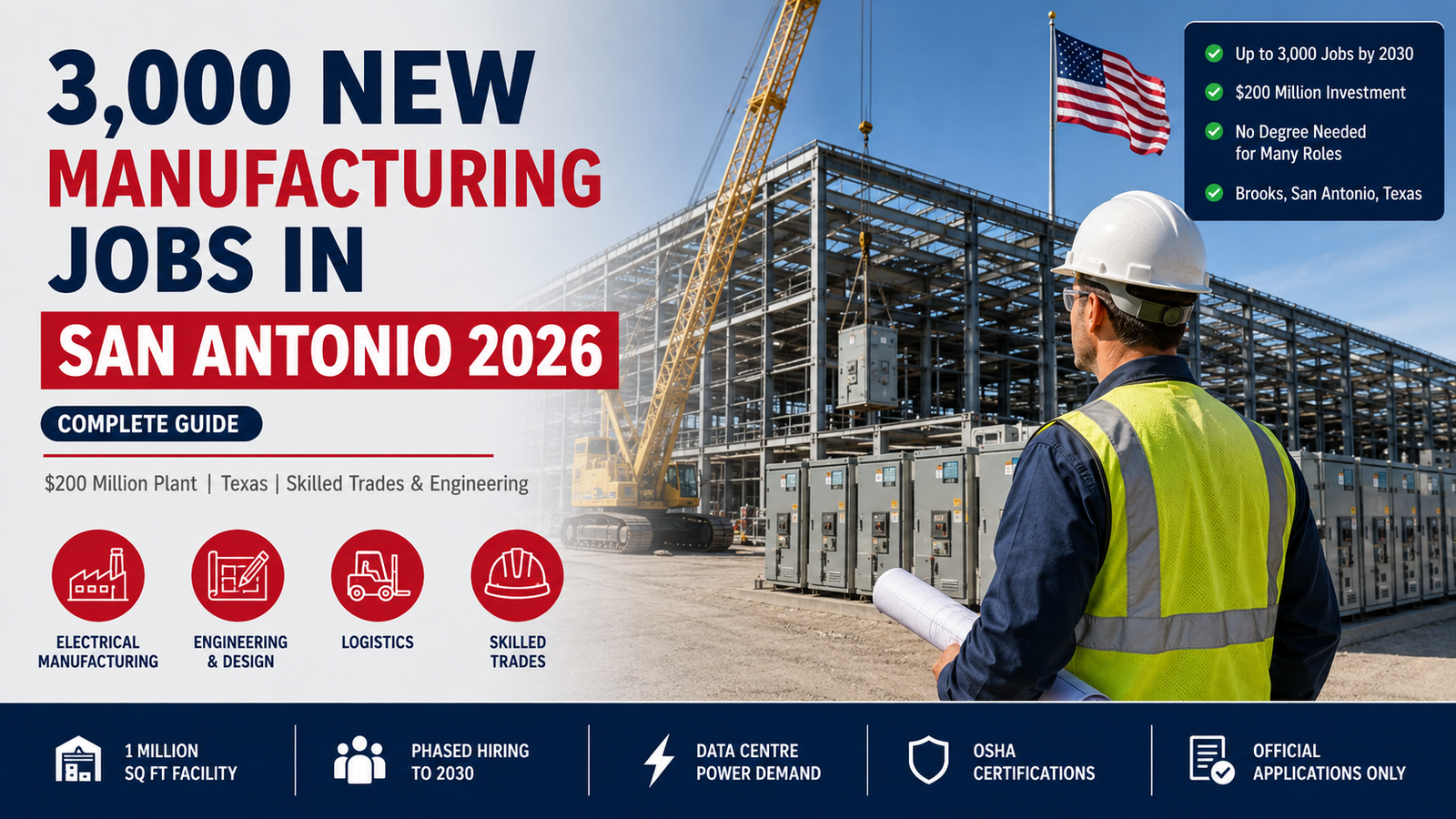
San Antonio has just landed the biggest job-creating industrial project it has seen in more than two decades. A California-based electrical equipment manufacturer confirmed this week that it will build a one-million-square-foot production facility on the city’s southeast side, backed by a $200 million investment and a hiring plan that reaches up to 3,000 workers by 2030.
For anyone tracking San Antonio manufacturing jobs 2026, this is the single most important announcement of the month. It is not a temporary contract or a seasonal warehouse push — it is a long-term factory build with engineering, production, logistics and corporate roles attached to it.
What Was Announced
The company behind the project is IEM (Industrial Electric Mfg.), headquartered in Fremont, California, and founded in 1957. IEM is North America’s largest independent manufacturer of electrical distribution and integrated control systems — essentially the switchgear and power distribution equipment that keeps large buildings, hospitals, factories and data centres running.
The new plant will be located at Brooks, the redeveloped former air force base in southeast San Antonio. Key figures from the announcement:
- Investment: $200 million
- Facility size: approximately 1 million square feet
- Jobs: up to 3,000 by 2030
- State support: a Texas Enterprise Fund grant tied to an initial commitment of 448 jobs
- Build-out: phased construction, with detailed timelines still to be released
Local economic development officials described it as the region’s largest job-producing investment in over twenty years.
Why This Project Exists: The Data Centre Power Boom
This is the part most job seekers miss, and it is the part that tells you whether the hiring will last.
IEM’s customer list includes some of the largest technology companies in the United States. Demand for its equipment is being driven by the enormous build-out of data centres and AI computing infrastructure across America. Every new data centre needs switchgear, power distribution units and control systems — and manufacturers cannot produce them fast enough.
That means the roles created here are tied to a structural, multi-year demand cycle rather than a one-off contract. For someone planning a career move, that distinction matters more than the headline number.
Which Jobs Will Actually Be Available
The company has indicated hiring across four broad families of roles. Based on how electrical equipment plants of this type are staffed, here is what candidates should realistically expect:
Production and skilled trades
- Electrical assemblers and panel builders
- Wiring technicians
- Sheet metal fabricators and welders
- Machine operators
- Painters and finishers
- Quality inspectors and test technicians
Engineering and technical
- Electrical design engineers
- Manufacturing and process engineers
- Controls and automation engineers
- CAD and drafting specialists
- Project engineers
Logistics and supply chain
- Material handlers and forklift operators
- Inventory and warehouse coordinators
- Procurement and sourcing specialists
- Production planners and schedulers
Corporate and support
- Human resources and recruitment
- Finance and accounting
- Safety and compliance (EHS)
- IT and systems support
- Customer and project management
A large share of the production floor positions in this industry do not require a four-year degree. A technical certificate, a trade school background, or verified hands-on experience is typically the entry requirement.
Skills That Will Give You an Advantage
If you want to be shortlisted when hiring opens, start building the profile now rather than waiting for a job posting.
- Blueprint and schematic reading — the ability to work from electrical drawings is the single most requested skill on a switchgear floor.
- Hands-on wiring and torque discipline — clean, standard-compliant terminations.
- Safety certification — OSHA 10 or OSHA 30 credentials are widely expected in US manufacturing.
- NFPA 70E awareness — electrical safety in the workplace.
- Basic measurement and quality tools — calipers, multimeters, continuity and hi-pot testing familiarity.
- Forklift certification — for material handling roles.
- AutoCAD or SolidWorks — for drafting and engineering tracks.
- Lean manufacturing basics — 5S and continuous improvement language shows up in almost every interview.
For engineering applicants, experience with low-voltage and medium-voltage distribution equipment, UL standards, or data centre power topology will place you ahead of general applicants.
Hiring Timeline: Be Realistic
This is a construction project first and a hiring event second. The company has not yet published a start date for applications, a wage scale, or the phase-by-phase headcount schedule beyond the initial commitment tied to state incentives.
What that means in practice:
- The earliest roles will most likely be construction, project management and corporate setup positions.
- Production hiring typically begins only as the first phase of the facility nears completion.
- The full 3,000-person target is spread across roughly four years, through 2030 — not a single hiring drive.
Anyone promising you a confirmed job at this plant today does not have accurate information. Treat such offers with caution.
How to Prepare and Apply Safely
- Go directly to the company’s own careers page. Official openings appear there first.
- Set up job alerts for San Antonio and Bexar County manufacturing roles so you see postings on day one.
- Never pay a fee for a job application, an interview slot, or a “reservation” at a US facility. Legitimate American employers do not charge candidates.
- Verify the recruiter. Cross-check any email or phone contact against the company’s official domain.
- Build a US-format resume — one to two pages, achievement-focused, with certifications listed clearly near the top.
- Prepare for a skills test. Production roles in this sector frequently include a practical assessment.
What It Means for the Wider Texas Job Market
Texas continues to attract advanced manufacturing because of its industrial power capacity, land availability, workforce pipeline and state incentive programmes. San Antonio in particular has been building a base in aerospace, cybersecurity, healthcare and now heavy electrical manufacturing.
A plant of this size also produces a second wave of employment that never appears in the headline: suppliers, transport contractors, maintenance firms, staffing agencies, food service and housing demand around Brooks. For local job seekers, that ripple can open opportunities long before the factory floor is even finished.
Frequently Asked Questions
How many jobs will the new San Antonio plant create?
Up to 3,000 positions by 2030, with an initial commitment of 448 jobs tied to state incentive funding.
When does hiring start?
Specific hiring dates have not been announced. Construction is phased, and production hiring usually follows the completion of the first phase.
Do I need a degree to apply?
Many production and skilled trades roles in electrical manufacturing accept technical certificates or relevant hands-on experience instead of a four-year degree. Engineering roles normally require a degree.
Where exactly is the facility?
At Brooks, on the southeast side of San Antonio, Bexar County, Texas.
What does the company make?
Electrical distribution and integrated control systems — including switchgear and power distribution equipment used in data centres, healthcare, energy and industrial facilities.