
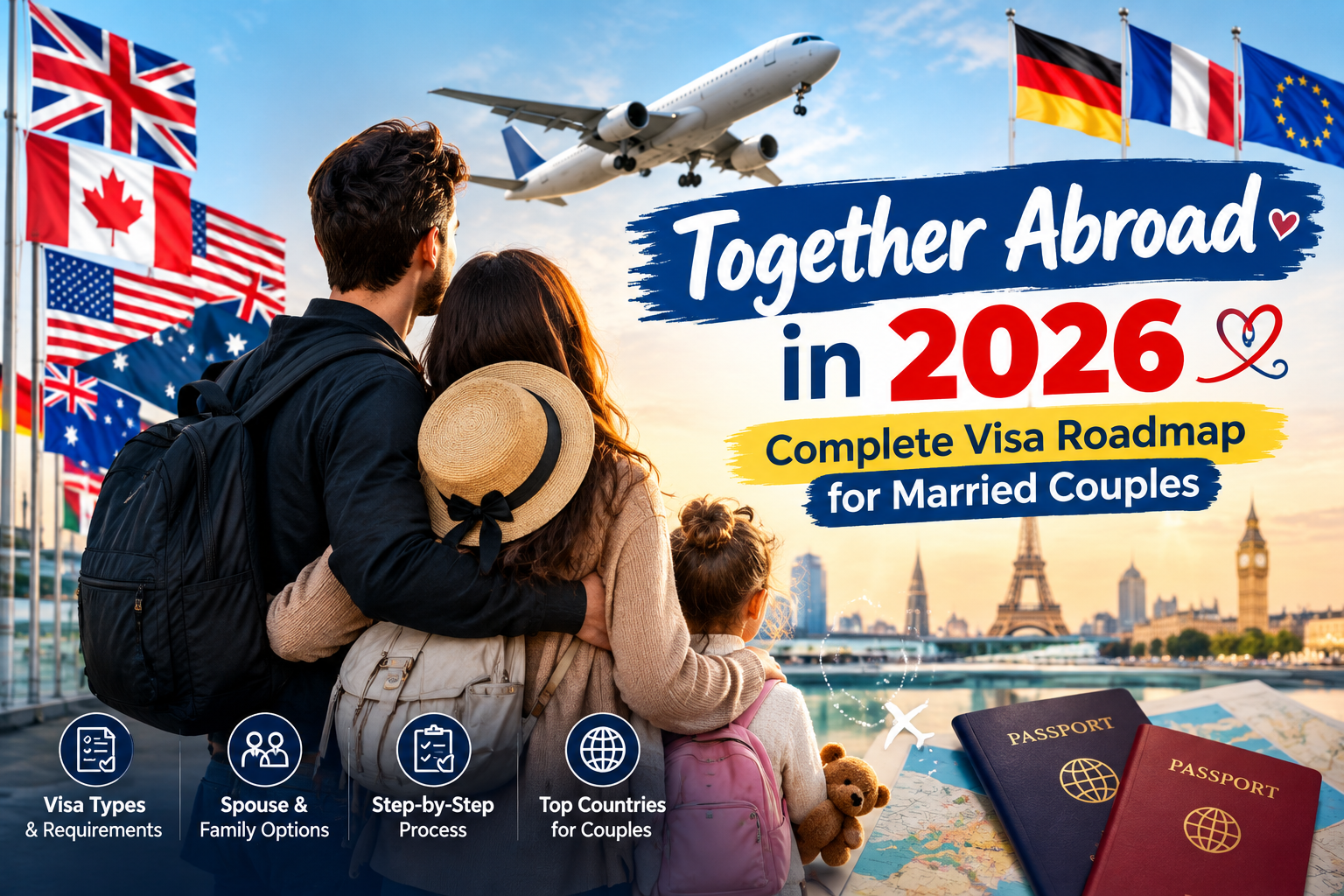
Starting a new life abroad can be a major step for a married couple. When one spouse already lives in another country or has an opportunity to move abroad the next goal is often to find a legal way for both partners to live together.
For married couples this process can involve a spouse visa family reunification visa family sponsorship or another type of family residence permit. The name of the immigration route depends on the country and the immigration status of the sponsoring spouse.
In 2026 couples planning to move abroad should carefully understand the requirements before submitting an application. Marriage alone does not automatically provide a right to live in another country. Immigration authorities can have requirements related to the sponsor’s status relationship finances accommodation language and other eligibility conditions.
This guide provides a practical roadmap for married couples who want to understand the main steps involved in moving abroad together.
What Is a Visa for Married Couples?
A spouse or family visa is an immigration route that can allow an eligible husband or wife to join their spouse in another country.
The spouse already living in the destination country is usually known as the sponsor. The spouse who wants to join them is generally the applicant.
The sponsor could be a citizen permanent resident or a foreign worker with an eligible residence permit depending on the country’s rules.
For example the UK has a family visa route for qualifying spouses and partners. Canada has a family sponsorship system for eligible spouses and the United States has family-based immigration routes for qualifying spouses.
Because every immigration system is different couples should identify the correct country-specific route before preparing their application.
Step 1: Decide Where You Want to Live
The first step is choosing the destination country.
A couple may already have one spouse working abroad. Another couple may be considering a country because of employment opportunities education lifestyle or long-term settlement.
Before making the final decision couples should research more than visa requirements.
They should also consider employment housing healthcare transportation taxes education for children and the overall cost of living.
A country with a simple family visa may have expensive housing while another country may have attractive employment opportunities but stricter language requirements.
The best destination for a couple depends on their own circumstances.
Step 2: Check the Sponsor’s Status
After selecting a country determine the immigration status of the spouse who will sponsor the application.
This is one of the most important parts of the process.
A citizen may have different sponsorship rights from a permanent resident. A temporary worker may have different family options again.
For example Canada generally allows a sponsor to be at least 18 and to be a Canadian citizen permanent resident or a person registered under the Canadian Indian Act subject to the other eligibility requirements. A permanent resident must live in Canada to sponsor while a Canadian citizen living abroad must show an intention to return to Canada when the sponsored family member becomes a permanent resident.
This is why couples should identify the sponsor’s exact status before selecting a visa category.
Step 3: Choose the Correct Visa Route
The next step is finding the correct immigration category.
Depending on the destination the route may be called:
-
Spouse visa
-
Partner visa
-
Family visa
-
Family reunification visa
-
Spousal sponsorship
-
Family residence permit
The name is not as important as the legal requirements attached to the route.
For example the UK family visa route allows eligible spouses and partners to live together in the UK when the required conditions are met.
Canada’s system involves a sponsorship application and a permanent residence application for eligible family members.
The United States uses family-based immigrant visa procedures for qualifying spouses of U.S. citizens and other eligible sponsors.
Step 4: Prepare Your Marriage Documents
A legally recognised marriage is normally central to a spouse immigration application.
Couples should prepare their marriage certificate and other civil documents well before submitting an application.
Depending on the country the documents may include passports national identity documents birth certificates and previous marriage or divorce records where applicable.
If documents are not written in an accepted language certified translations may be required.
The information across documents should also be consistent. Names dates of birth and marriage dates should match unless there is a documented reason for a difference.
For Canada a spouse must be legally married to the sponsor and the marriage must meet the country’s recognition rules.
Step 5: Prove That Your Marriage Is Genuine
Some immigration authorities require evidence that a marriage is genuine and not entered into primarily for immigration purposes.
Couples may need to explain how they met when they started their relationship when they married and how they have maintained their relationship.
Evidence can include photographs travel records communication history shared financial responsibilities and other genuine records.
The purpose is to provide a clear picture of the relationship.
Couples should not create fake conversations photographs or documents.
For example Canada’s current requirements state that a sponsored spouse must be in a genuine relationship with the sponsor and not in the relationship only to obtain permanent resident status.
The UK also provides examples of relationship evidence including marriage certificates shared expenses shared addresses and evidence of ongoing communication when partners do not live together.
Step 6: Check the Financial Requirements
Financial requirements vary significantly between countries.
Some countries require a sponsor to demonstrate a specific level of income. Others use different financial rules.
The UK currently requires most new partner and spouse applicants to show combined income of at least £29 000 per year although exceptions and different rules can apply in certain situations.
Canada works differently. In most cases there is no minimum necessary income requirement when sponsoring a spouse partner or dependent child although the sponsor still has financial obligations and certain exceptions can apply.
This is why couples should never copy a financial requirement from another country’s visa guide.
The correct financial requirement is the one that applies to the specific immigration route.
Step 7: Check Language Requirements
Language requirements can also be part of the visa process.
Some countries require the joining spouse to demonstrate knowledge of the local language or English.
The UK family visa route for example generally requires qualifying partner and spouse applicants to demonstrate knowledge of English subject to applicable exemptions.
Language preparation can also help after arrival.
Even when a language test is not required learning the local language can make it easier to find employment communicate with government offices use healthcare services and manage everyday life.
Step 8: Check Accommodation Requirements
Housing can be another part of family immigration planning.
Some countries require evidence that the family has suitable accommodation.
Couples should therefore research where they will live before the application is submitted.
Useful documents can include a rental agreement property documents or other evidence accepted by the immigration authority.
Even when accommodation is not a formal visa requirement planning housing early can make the move easier.
The couple should consider rent deposits utilities transportation and the distance between home and work.
Step 9: Prepare Your Complete Document File
Once the main requirements are clear couples can begin preparing their documents.
A typical file may include:
-
Valid passports
-
Marriage certificate
-
Identity documents
-
Birth certificates where required
-
Sponsor’s passport or residence documents
-
Employment documents
-
Financial evidence
-
Accommodation documents
-
Relationship evidence
-
Language certificate where applicable
-
Police certificates where required
-
Medical documents where required
-
Certified translations
The exact list depends on the country.
Applicants should use the official document checklist for their particular visa category rather than relying on a generic checklist found online.
Step 10: Submit the Application
After preparing the documents the applicant can submit the visa or residence application through the appropriate official system.
The process may be online through an embassy or consulate or through another authorised application centre.
For example Canada currently requires eligible spouse sponsorship applications to include both the sponsorship application and the permanent residence application submitted through its online process.
The UK also requires family visa applicants to apply online with the process depending on whether the applicant is inside or outside the UK.
Applicants should carefully review every answer before submitting the application.
Step 11: Complete Biometrics and Other Requirements
After submitting an application the applicant may need to complete biometrics.
Depending on the country and visa category additional steps can include an interview medical examination police certificate or requests for further documents.
Applicants should respond to official requests within the required deadline.
Ignoring a request can cause unnecessary delays or problems.
Step 12: Wait for the Decision
Processing time depends on the country visa category application volume and individual circumstances.
For example the UK currently states that applications made outside the UK for a partner or spouse family visa usually receive a decision within 12 weeks while qualifying applications made inside the UK usually take around 8 weeks.
These are published service expectations rather than a guarantee that every application will be decided within that period.
Couples should avoid making non-refundable travel plans until the necessary immigration permission has been granted.
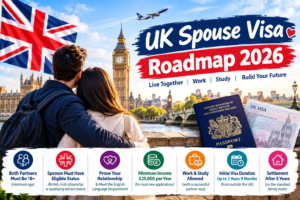
UK Spouse Visa Roadmap 2026
The UK is one of the countries commonly considered by married couples planning to live together.
The UK family visa route allows eligible spouses and partners to apply when the relevant conditions are satisfied.
Both partners generally need to be at least 18. The sponsor must have an eligible status such as British or Irish citizenship or qualifying settled status and the couple must intend to live together permanently in the UK.
The couple generally needs to demonstrate the relationship meet the English-language requirement and satisfy the applicable financial rules.
For most new partner applications the current minimum income requirement is £29 000 per year.
A successful partner family visa normally allows the applicant to work and study in the UK.
The initial partner family visa can generally provide up to 2 years and 9 months of permission when applying from outside the UK with further permission available if the requirements are met. The earliest settlement under the standard five-year family route is generally after five continuous years on a family visa as a partner.
Canada Spousal Sponsorship Roadmap 2026
Canada has a family sponsorship system for eligible spouses and other family members.
A Canadian sponsor generally needs to be at least 18 be a Canadian citizen permanent resident or registered person under the Canadian Indian Act and meet the other sponsorship conditions.
The sponsored spouse must generally be at least 18 legally married to the sponsor in a genuine relationship and admissible to Canada.
The application has two connected parts: the sponsorship application and the permanent residence application. The current application process is online through the Permanent Residence Portal.
Couples should also declare all required family members in the application and follow the country-specific document instructions.
USA Spouse Immigration Roadmap
The United States uses a family-based immigration system for eligible spouses.
For a foreign spouse of a U.S. citizen who is applying from outside the United States the process generally starts with an immigrant petition.
After the petition stage the case can proceed through document processing financial sponsorship requirements medical examination and an immigrant visa interview.
The IR-1 and CR-1 categories are commonly associated with spouses of U.S. citizens.
The exact procedure depends on the applicant’s circumstances and immigration category so couples should follow the current instructions from U.S. immigration authorities.
Germany and European Family Reunification
Germany and other European countries have family-reunification routes for qualifying spouses.
However couples should not assume that one European country’s rules automatically apply to another.
The sponsor’s residence status can affect the application.
Financial resources accommodation health insurance and language requirements may also be relevant depending on the country and circumstances.
For this reason couples planning to move to Europe should first choose the specific country and then research that country’s current family-reunification rules.
Can the Joining Spouse Work?
The right to work depends on the visa or residence permit.
A spouse should not automatically assume that every family visa gives unrestricted work rights.
Some countries allow spouses to work after receiving the relevant residence status while other permits may have specific conditions.
Before accepting employment the joining spouse should check the work conditions attached to their immigration document.
This is particularly important for regulated professions where additional licensing or qualification recognition may be required.
Moving Together or Moving Separately
Some couples move abroad together while others move in stages.
Moving together can make the transition easier because both partners can start their new life at the same time.
However moving separately can sometimes be more practical.
For example one spouse may need to begin a job arrange accommodation or establish a home before the other spouse arrives.
The choice depends on the immigration process finances employment and family responsibilities.
The important thing is to make sure both partners have the correct legal permission before travelling or working.
Planning for Children
Children should be included in the immigration plan from the beginning.
Parents may need to provide birth certificates passports custody documents and other records.
Some countries require information about all family members even when a child is not travelling immediately.
Canada for example requires applicants to declare all family members and provide the required information and examinations where applicable.
Parents should also research schools healthcare childcare and housing before moving.
Planning these areas early can make the first months in a new country much easier.
Financial Planning Before the Move
Visa approval does not mean that the relocation will be inexpensive.
Couples should prepare a realistic budget before travelling.
Expenses can include visa fees flights accommodation deposits rent food transportation healthcare mobile services and emergency costs.
The couple should also consider the possibility that one spouse may not find employment immediately.
An emergency fund can provide useful financial support during the first few months.
Building a Life After Arrival
Once the couple arrives there will be several practical tasks.
Depending on the country they may need to register their address arrange healthcare open a bank account obtain local identification documents and understand tax responsibilities.
The joining spouse should also confirm the conditions attached to their residence permission.
If the permission is temporary couples should note the expiry date and understand the requirements for an extension.
Immigration planning should continue after arrival.
Long-Term Plans for Married Couples
Many couples eventually want permanent residence or citizenship.
These are separate immigration goals and normally require additional conditions.
Depending on the country requirements can include a specific period of legal residence language ability integration requirements employment or financial conditions and compliance with immigration rules.
A spouse visa should therefore not automatically be treated as a guarantee of permanent residence.
Couples who want to settle permanently should research the long-term pathway from the beginning.
Common Mistakes to Avoid
One common mistake is selecting the wrong visa category.
Another is submitting incomplete or outdated documents.
Inconsistent information can also create problems particularly when dates addresses employment history or relationship details do not match.
Couples should never submit fake relationship evidence or altered documents.
They should also be careful with people who promise guaranteed visa approval.
There is no legitimate way to guarantee the outcome of an immigration application simply by paying an agent.
A Simple 2026 Roadmap
For married couples the entire process can be understood as a series of steps.
Choose the country.
Decide where you want to build your new home and research the country’s immigration system.
Check the sponsor.
Confirm the citizenship or residence status of the spouse who will the sponsor the application.
Find the correct route.
Identify the spouse visa family visa sponsorship program or family-reunification permit that applies.
Prepare marriage evidence.
Collect the marriage certificate and genuine relationship evidence.
Check financial and language rules.
Confirm the current requirements before preparing the application.
Prepare documents.
Collect passports civil documents financial records accommodation evidence and the other required paperwork.
Submit the application.
Use the official application system and the pay the required fees.
Complete biometrics and additional requirements.
Attend appointments and the provide further evidence when requested.
Wait for the decision.
Avoid making major non refundable travel arrangements until the required permission is the granted.
Prepare for the move.
Arrange accommodation finances employment planning and other practical matters.
Final Thoughts
Moving abroad together can be an exciting new chapter for a married couple but the journey should begin with a clear immigration plan.
The correct route depends on the destination country and the immigration status of the sponsoring spouse. A couple may use a spouse visa family reunification route family sponsorship program or another family residence category.
In 2026 the UK Canada the United States and European countries all have different systems and requirements. The UK currently has specific relationship English-language and financial requirements for many spouse applicants while Canada’s spousal sponsorship system has its own eligibility and application process.
The most important part of the process is preparation.
Couples should use genuine documents follow the official requirements check current rules before applying and the avoid anyone promising guaranteed visas or guaranteed immigration results.
With a clear roadmap realistic financial planning and careful preparation married couples can better understand the steps involved in the building their life together abroad in 2026.