
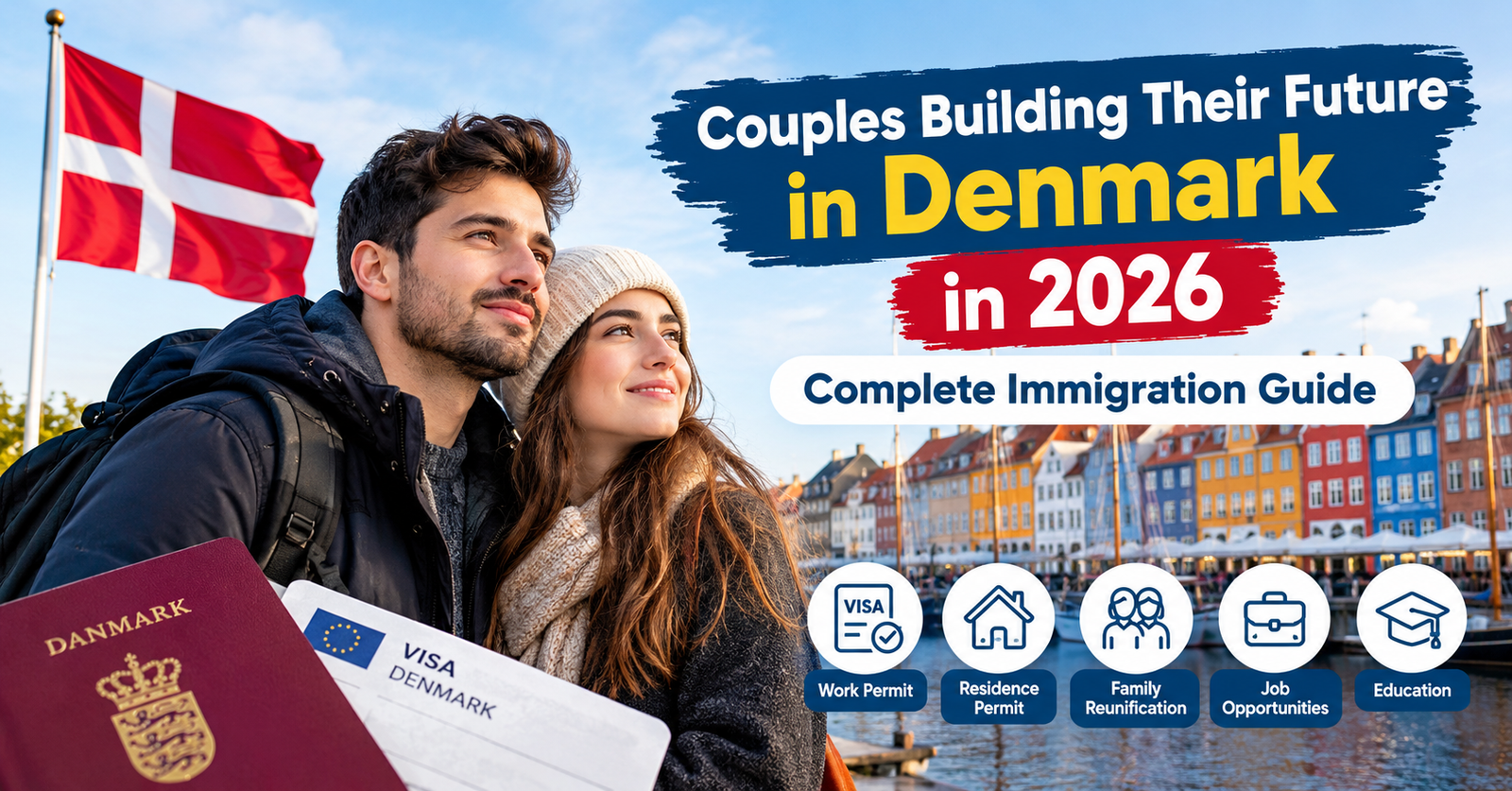
Moving to Denmark as a married couple can be an exciting opportunity for people who want to build a stable future in Europe. Denmark is known for its strong economy high living standards developed public services and demand for workers in several professional and skilled occupations.
However moving to Denmark as a couple is not based on one single visa. The correct immigration route depends on your family situation employment education residence status and nationality.
One spouse may move to Denmark for work while the other applies as an accompanying family member. A Danish citizen or permanent resident may be able to apply for family reunification with a spouse. In some situations an EU or EEA citizen living in Denmark can bring a spouse under EU rules.
Denmark also has work routes for qualified international workers. The Pay Limit Scheme requires a minimum annual salary of DKK 552,000 for applications submitted in 2026 while the Positive Lists provide routes for certain occupations where Denmark has a shortage of qualified workers.
This complete guide explains the main Denmark immigration options for couples in 2026 including spouse visas family reunification work permits accompanying family rules financial requirements documents children language requirements and a practical application roadmap.
Can Married Couples Move to Denmark in 2026?
Yes. Married couples can potentially move to Denmark together but the immigration process depends on the situation of the couple.
For example a foreign worker may receive a Danish residence and work permit and their spouse may apply as an accompanying family member.
A person who is already living in Denmark may also be able to bring a spouse through family reunification.
EU and EEA citizens exercising their free-movement rights in Denmark have separate rules for bringing family members. Under EU rules a spouse can generally qualify when the EU or EEA citizen is genuinely exercising a right of residence in Denmark such as working studying or being self-employed.
Therefore the first step should always be identifying which immigration category applies to your family.
Main Immigration Routes for Couples in Denmark
There are several important routes that couples can explore.
Family Reunification With a Spouse
This route can apply when one spouse is living in Denmark and the other wants to join them.
Denmark has specific family reunification requirements for spouses. These can include age relationship integration housing financial support and other conditions depending on the sponsor’s status.
Accompanying Family Member of a Worker
If one spouse receives a Danish residence permit for employment the other spouse may potentially apply as an accompanying family member.
This route is particularly relevant to international workers who move to Denmark for skilled employment.
An accompanying family member to an employee generally has the right to work in Denmark without applying for a separate work permit. They can also generally run a business or study subject to the applicable rules.
Work Permit for the Main Applicant
One spouse can independently qualify for a Danish work and residence permit.
Possible routes include the Pay Limit Scheme Fast-Track Scheme and Positive List routes depending on the job qualifications employer and salary.
EU Family Member Route
If an EU or EEA citizen genuinely exercises free-movement rights in Denmark the spouse may have rights under EU rules.
This can be different from ordinary Danish family reunification and may have different requirements.
Denmark Family Reunification for Married Couples
Family reunification is one of the most important routes for married couples where one spouse already lives in Denmark.
The Danish Immigration Service states that a person with a spouse or partner living in Denmark may qualify for a residence permit under the family reunification rules when the applicable conditions are met. The current listed application fee is DKK 8,490 and the expected maximum processing time is 10 months.
The exact requirements can be strict.
Applicants should not assume that a legal marriage alone automatically gives the foreign spouse a residence permit.
The authorities can assess the relationship and other conditions before making a decision.
The 24-Year Requirement
One important Denmark family reunification rule is the age requirement.
Normally both spouses or partners must be at least 24 years old to qualify for family reunification under the ordinary spouse rules. The applicant can submit the application when the younger spouse is 23 years and 6 months old. There are exceptions where the requirement can be suspended in special circumstances.
This is especially important for young married couples planning to move to Denmark.
Before paying the application fee couples should check whether they meet the age requirement or whether an exemption may apply.
Genuine Marriage and Relationship
Denmark can assess whether the marriage or relationship is genuine and voluntary.
The authorities can consider factors such as whether the couple have lived together whether they can communicate in a common language how well they knew each other before marriage their age difference previous marriages and whether they have children together.
This does not mean that every couple must have the same relationship history.
It means applicants should provide truthful information and genuine evidence of their relationship.
A marriage entered into mainly to obtain residence can create serious immigration problems.
Integration Requirements for Spouse Family Reunification
Denmark can apply an integration requirement to ordinary spouse family reunification cases.
Normally the couple collectively need to meet four out of six integration-related conditions. Some conditions apply to the applicant while others apply to the spouse living in Denmark.
The applicant may be able to meet conditions through factors such as Danish or English language ability work experience and education.
For example the Danish Immigration Service states that passing Prøve i Dansk 1 or an equivalent Danish test can count as one condition. An English test at B1 level or an equivalent test can also satisfy the relevant language condition. Work of at least three of the previous five years and at least one year of education can also be relevant conditions.
The exact combination depends on both spouses.
Danish Language Requirements After Approval
Language requirements can continue after family reunification is granted.
Under the ordinary rules an approved applicant will normally need to pass a Danish test at A1 level and later A2 level within the specified deadlines.
The current information states that the A1 test is normally required within six months of being granted the residence permit and the A2 test within nine months. Failure to meet the requirements can have consequences for the residence permit.
There are exceptions and special situations where requirements can be suspended.
Couples should therefore check the exact conditions attached to their residence permit.
Financial Support Requirement
The spouse living in Denmark normally needs to be able to support themselves.
The Danish Immigration Service states that receiving certain forms of social benefits under the Active Social Policy Act or Integration Act during the relevant period can prevent the family reunification application from being approved. Even short periods of certain social benefits can be important.
This means couples should review the sponsor’s financial history before submitting the application.
Financial Guarantee in 2026
Another important requirement can be a financial guarantee.
For ordinary spouse family reunification the sponsor in Denmark normally needs to provide a financial guarantee.
The current 2026 amount is DKK 61,709.34. The guarantee can potentially be reduced after the applicant passes certain Danish language tests.
For example the current rules state that the guarantee can be reduced by DKK 12,341.87 after passing Danish A1 and by further amounts after completing higher Danish tests.
Special circumstances can result in exceptions or suspension of some requirements.
Housing Requirement
Housing is another important part of ordinary spouse family reunification.
The spouse living in Denmark may need to show that the accommodation meets the applicable conditions.
The authorities can assess whether the home is suitable under the relevant family reunification rules.
Applicants should therefore keep documents such as:
-
Rental agreement
-
Housing documentation
-
Address information
-
Property documents where applicable
-
Other evidence requested by the authorities
Do not wait until the last moment to prepare housing evidence.
Documents for Denmark Spouse Visa
The exact document list depends on the case but couples should generally be prepared to provide important identity family financial and residence documents.
Common documents can include:
-
Valid passport
-
Marriage certificate
-
Authorized translation of marriage certificate where required
-
Passport copies
-
Proof of residence
-
Proof of housing
-
Financial documents
-
Employment documents
-
Education records
-
Language certificates
-
Relationship evidence where relevant
-
Children documents
-
Previous immigration documents where applicable
The Danish Immigration Service currently lists the marriage certificate with an authorised translation into Danish or English among the documents that may be required for married applicants.
Always check the current application form before submitting your documents.
Denmark Work Visa for Couples
Another practical option is for one spouse to qualify for employment in Denmark.
Denmark has several work immigration schemes for international workers.
The best route depends on the occupation salary qualifications employer and job conditions.
Two important options in 2026 are the Pay Limit Scheme and Positive List routes.
Denmark Pay Limit Scheme 2026
The Pay Limit Scheme is based primarily on salary rather than a particular shortage occupation.
For applications submitted from 1 January 2026 the minimum annual salary is DKK 552,000, equal to DKK 46,000 per month. The salary and employment conditions must also correspond to Danish standards.
This can be useful for qualified professionals who have a sufficiently high-paying Danish job.
However reaching the salary threshold does not automatically guarantee approval.
The job employer contract and other immigration conditions still matter.
Denmark Positive List 2026
The Positive Lists can be another important route for foreign workers.
Denmark maintains separate Positive Lists for people with higher education and skilled work occupations where there are shortages of qualified workers.
From 1 July 2026 the Positive List for People with a Higher Education contains 164 job titles, while the Positive List for Skilled Work contains 63 job titles.
This can be particularly useful for couples where one spouse has a qualification in an occupation currently included on the applicable list.
Because the lists can change applicants should check the current occupation list before applying.
Examples of Jobs Couples Can Explore
Depending on qualifications and the current immigration lists employment opportunities can include areas such as:
-
IT
-
Engineering
-
Healthcare
-
Construction
-
Skilled trades
-
Manufacturing
-
Technical services
-
Industrial work
-
Education
-
Finance
-
Research
-
Logistics
-
Green energy
-
Professional services
Not every job in these sectors qualifies for a residence permit.
The exact occupation code qualification requirements salary and employment conditions should always be checked.
Accompanying Spouse of a Danish Worker
If one spouse moves to Denmark for employment the other spouse can potentially apply as an accompanying family member.
This can be an attractive option because an accompanying family member of an employee generally has the right to work in Denmark without obtaining a separate work permit. The spouse can also generally study or operate a business under the applicable rules.
This means a couple may not need to depend on only one income after arriving.
The accompanying spouse can potentially search for suitable employment after receiving the relevant residence permit.
Couples Moving Through Study in Denmark
Study-based immigration needs special attention in late 2026 because Denmark changed rules affecting accompanying family members of certain international students.
From 1 October 2026, new rules mean that spouses and other accompanying family members of certain third-country students in state-approved higher educational programmes may no longer receive residence permits under the accompanying-family route when the student applies on or after that date.
There are important transitional rules.
For example if the student applied before 1 October 2026 and the spouse also submitted their accompanying-family application before 1 October 2026 the previous route may still apply. PhD students are treated differently and their accompanying family members can still qualify under the applicable rules.
This is a major point for couples considering Denmark through education in late 2026.
Do not rely on older articles that say every international student can bring a spouse to Denmark.
Can the Spouse Work in Denmark?
For many accompanying-family permits connected to employment the spouse can work in Denmark without a separate work permit.
The Danish immigration authority states that an accompanying family member of an employee generally has the right to work and can also run a business or study.
There can be an exception when the spouse wants to work for the same company as the sponsor or a closely related company.
Therefore the spouse should read the conditions attached to their residence permit before starting employment.
Can Couples Bring Their Children?
Eligible children can potentially accompany parents depending on the immigration route.
Family reunification rules can cover certain minor children while accompanying-family rules also provide routes for eligible children under the relevant work and study categories.
However the rules are not identical for every immigration route.
Couples should prepare birth certificates custody documents and other evidence where applicable.
If only one parent is travelling with a child additional documentation may be required.
Denmark Immigration for EU Couples
EU and EEA citizens can have different rights from non-EU nationals.
Under EU free-movement rules a Union citizen or EEA national genuinely residing in Denmark as a worker self-employed person student or another qualifying category can potentially bring eligible family members. A spouse is one of the main family relationships covered by these rules.
A genuine family relationship must exist.
A third-country spouse may need a visa to enter Denmark if their nationality is subject to visa requirements but can then apply for the appropriate residence card under EU rules where eligible.
How to Apply for Denmark Immigration as a Couple
The exact process depends on the route but a simple roadmap can help.
Step 1: Decide Your Immigration Route
Determine whether you will use:
-
Spouse family reunification
-
Employment
-
Pay Limit Scheme
-
Positive List
-
Accompanying family
-
EU family-member rules
-
Another applicable route
Step 2: Check Eligibility
Review the current requirements for both spouses.
Check age relationship employment income housing qualifications and other conditions.
Step 3: Prepare Documents
Collect passports marriage certificate employment documents financial records education certificates and other required evidence.
Step 4: Complete the Correct Application
Denmark uses specific application forms for different immigration categories.
For ordinary spouse family reunification the current application is the FA1 form. The Danish Immigration Service lists the online FA1 application as updated in March 2026.
Step 5: Pay the Required Fee
Where a fee applies make sure the correct amount is paid before submitting the application.
For ordinary spouse family reunification the current listed fee is DKK 8,490.
Step 6: Submit Biometrics and Documents
Follow the instructions for biometric information and document submission.
Applicants outside Denmark may be able to submit through a Danish mission or an authorised outsourcing office depending on their country of residence.
Step 7: Wait for the Decision
Processing time depends on the immigration route and individual circumstances.
For ordinary spouse family reunification the current expected maximum processing time shown by the Danish Immigration Service is 10 months.
Step 8: Travel and Settle
After approval complete the required entry process and begin planning accommodation registration employment language learning and other practical matters.
How Couples Should Prepare Financially
Immigration costs are only one part of the budget.
Before moving to Denmark couples should consider:
-
Visa and residence application fees
-
Travel costs
-
Housing deposit
-
Monthly rent
-
Utilities
-
Food
-
Transportation
-
Insurance
-
Language classes
-
Childcare
-
Emergency savings
-
Initial living expenses
Denmark can be an expensive country, especially in larger cities.
A couple should therefore compare the actual salary and housing costs before deciding where to live.
Common Mistakes Couples Should Avoid
Many immigration problems happen because applicants rely on outdated information or unofficial agents.
Couples should avoid:
-
Fake marriage documents
-
Fake employment contracts
-
False bank statements
-
Fake language certificates
-
Guaranteed visa promises
-
Paying unknown agents for a guaranteed residence permit
-
Applying under the wrong immigration category
-
Ignoring the 24-year rule
-
Ignoring financial guarantee requirements
-
Assuming every student can bring a spouse
-
Starting unauthorized employment
-
Using old information about Denmark’s Positive Lists
The safest approach is to use official Danish immigration information and genuine documents.
Long-Term Future in Denmark
Couples moving to Denmark should think beyond their first residence permit.
Maintaining lawful residence complying with permit conditions learning Danish where useful developing a stable employment history and keeping accurate records can help with future immigration planning.
Permanent residence is a separate immigration status with its own requirements.
Couples should not assume that receiving a temporary residence permit automatically leads to permanent residence or citizenship.
The requirements can also change over time so long-term plans should be reviewed against the rules in force when an application is actually submitted.
Quick Eligibility Checklist for Couples
Before starting your Denmark immigration journey check:
-
Are we legally married?
-
Do we both have valid passports?
-
Which spouse will be the main applicant?
-
Are we using family reunification or a work route?
-
If using family reunification do we meet the 24-year requirement?
-
Do any exemptions apply?
-
Can the sponsor meet the self-support requirement?
-
Is the required financial guarantee available?
-
Does the sponsor meet the housing requirement?
-
Do we meet the integration requirements?
-
Is our marriage certificate properly prepared?
-
Do we have the required translations?
-
Does the main applicant have a qualifying Danish job if using employment?
-
Does the salary meet the relevant scheme?
-
Is the occupation on the current Positive List if using that route?
-
If applying through study have we checked the new rules effective from 1 October 2026?
-
Have we prepared documents for children if they are moving with us?
Meeting a checklist does not guarantee approval because Danish authorities assess individual applications under the applicable immigration rules.
Simple 2026 Roadmap for Couples Building a Future in Denmark
A practical plan can look like this:
-
First: Decide which spouse will be the main immigration applicant.
-
Second: Identify the correct Denmark residence route.
-
Third: Check the current official requirements.
-
Fourth: Prepare passports marriage documents qualifications financial records and accommodation evidence.
-
Fifth: If using employment find a genuine Danish employer and confirm the job qualifies for the relevant scheme.
-
Sixth: If using family reunification check the age integration housing self-support and financial guarantee requirements.
-
Seventh: Complete the correct application and pay the applicable fee.
-
Eighth: Submit biometrics and supporting documents.
-
Ninth: Wait for the immigration decision.
-
Tenth: After approval complete the required entry and residence procedures.
-
Eleventh: Arrange housing employment education healthcare and daily-life needs.
-
Twelfth: Maintain lawful residence and prepare for future renewal or long-term residence requirements.
Final Thoughts
Couples building their future in Denmark in 2026 have several possible immigration pathways, but the correct route depends on their personal circumstances.
Family reunification can be an option for spouses of people living in Denmark. Employment routes can allow a qualified spouse to move through a Danish job, while accompanying-family rules can allow the other spouse to join and in many cases work in Denmark. EU citizens and their family members may have separate rights under EU rules.
For workers, Denmark’s 2026 immigration system includes the Pay Limit Scheme with a DKK 552,000 annual salary threshold and updated Positive Lists covering 164 higher-education occupations and 63 skilled-work occupations from July 2026.
For married couples using ordinary family reunification, requirements can be more demanding. The 24-year rule, integration requirements, self-support rules, housing conditions and financial guarantee should all be checked carefully before applying.
Couples considering Denmark through education should pay particular attention to the October 2026 changes affecting accompanying family members of certain international students.
The best approach is to choose the correct immigration route first, prepare genuine documents and verify the current Danish rules before submitting an application. A successful move is not only about getting a residence permit but also about planning employment housing finances language learning and long-term family goals.