
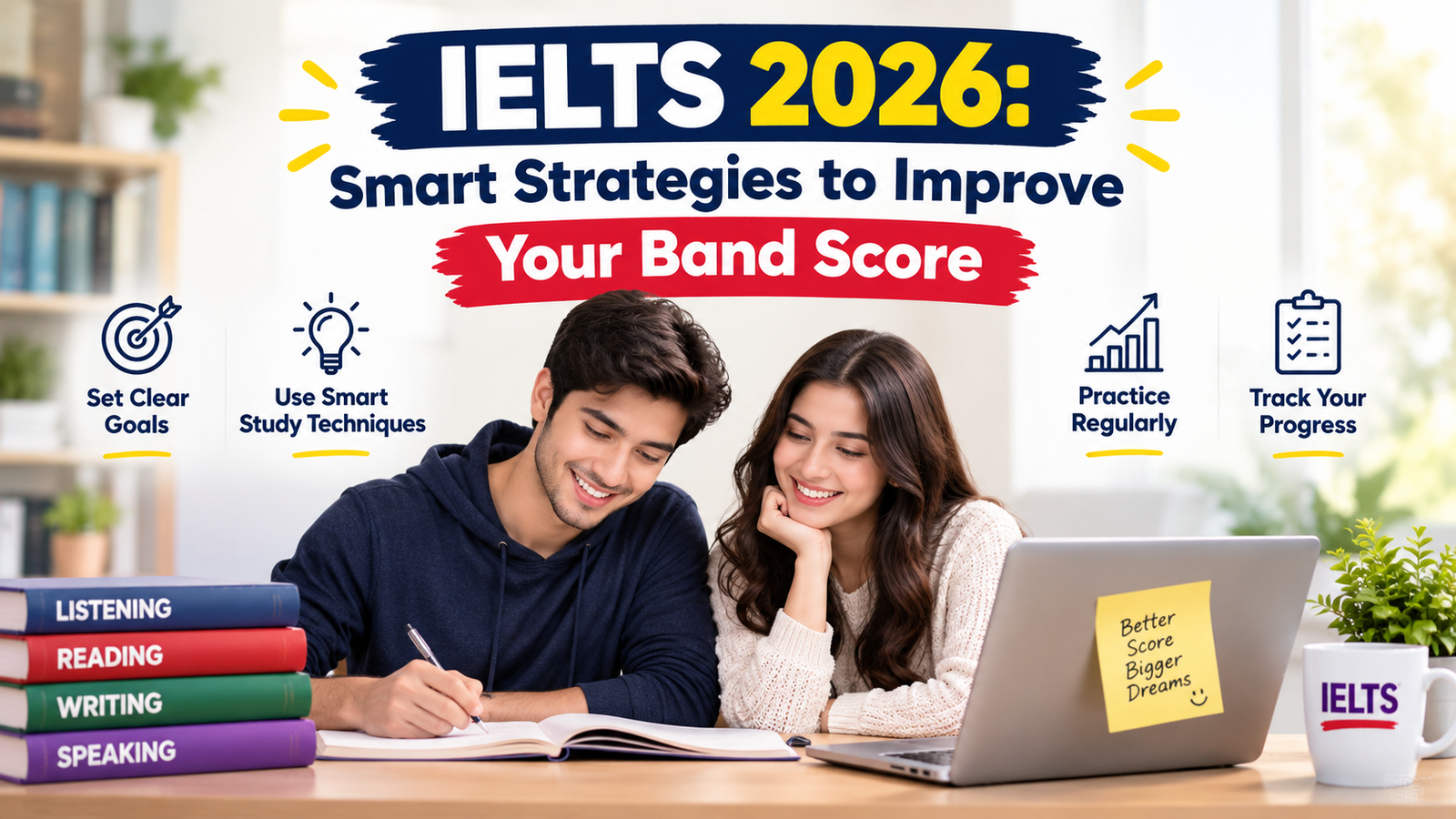
IELTS is one of the most widely used English language tests for people who want to study work or move abroad. A good IELTS score can be important for university admission employment professional registration and immigration.
However improving your band score is not simply about studying for many hours. You need to understand the test identify your weaknesses and practise the skills that need the most improvement.
This guide explains practical IELTS preparation strategies that can help you work toward a stronger band score in 2026.
Understand Your IELTS Goal
Before you start preparing find out exactly what score you need.
Your required score depends on your university employer professional organisation or immigration program. Some organisations may also require minimum scores in individual sections.
For example if you need an overall Band 7.0 but your Writing score is much lower than your Listening score you should spend more preparation time on Writing.
Knowing your target gives your preparation a clear direction.
Understand the Four IELTS Sections
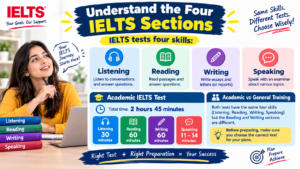
IELTS tests four skills:
Listening Reading Writing Speaking
The Academic IELTS test takes around 2 hours and 45 minutes. Listening takes about 30 minutes Reading 60 minutes Writing 60 minutes and Speaking normally takes 11 to 14 minutes.
Academic and General Training IELTS have the same four skills but their Reading and Writing sections are different.
Before preparing make sure you choose the correct test for your plans.
Take a Practice Test First
One of the best ways to begin is by taking a complete practice test.
Your first result does not need to be perfect. Its purpose is to show your current level.
You may discover that your Listening is strong but your Reading speed is slow. You may understand English well but struggle to organise your Writing or speak confidently.
Once you know your weaknesses you can create a more effective study plan.
Improve Your Listening
IELTS Listening requires concentration because you hear the recordings only once.
During practice do not simply check whether your answer is correct. Find out why you made a mistake.
You may have missed a word misunderstood the speaker or selected an answer too quickly.
Before each recording read the questions carefully and try to predict what information you need. Practise listening for names numbers dates places and other important details.
Spelling is also important because an incorrectly written answer can lose the mark.
You do not need to understand every single word. Focus on understanding the information required to answer the questions.
Improve Reading Speed and Accuracy
Many candidates lose marks in Reading because they spend too much time reading every word.
Instead learn to understand the general meaning of a passage and quickly locate the information required by the questions.
Pay attention to names dates numbers and important terms. If one question is taking too long move forward and return to it later if necessary.
IELTS Reading contains 40 questions and has a 60-minute time limit so time management is essential.
Regular timed practice can help you become faster without sacrificing accuracy.
Build Useful Vocabulary
A strong vocabulary can help in both Writing and Speaking but memorising hundreds of difficult words is not the best strategy.
Learn vocabulary through sentences and real examples. This helps you understand how words are actually used.
You can also learn alternatives for common words but avoid using complicated vocabulary simply to sound advanced.
Using a simple word correctly is better than using a difficult word incorrectly.
The goal is to use vocabulary naturally accurately and appropriately.
Improve IELTS Writing
Writing requires more than good vocabulary.
Your answer should directly address the question and present ideas in a clear and organised way. IELTS Writing is assessed through areas such as task achievement or task response coherence and cohesion lexical resource and grammatical range and accuracy.
Before writing take a short time to understand the question and plan your main ideas.
Your introduction should clearly introduce the topic. Main paragraphs should explain relevant ideas with reasons or examples and your conclusion should bring the response together.
For Academic IELTS Writing you have 60 minutes for two tasks. Task 1 requires at least 150 words while Task 2 requires at least 250 words.
Practise under timed conditions and always review your previous essays. If you repeatedly make the same grammar mistakes focus your study on those specific problems.
Improve Speaking Every Day
Speaking improves through speaking.
Practise talking about familiar topics such as your studies work hometown hobbies family and future plans.
You can record yourself and listen to the recording later. Notice unnecessary pauses repeated words pronunciation problems and grammar mistakes.
IELTS Speaking has three parts. Part 1 focuses on familiar topics Part 2 requires you to speak about a given topic and Part 3 involves a longer discussion.
Do not memorise complete answers. Instead prepare ideas and useful vocabulary for common topics so you can respond naturally.
Focus on Natural Fluency

You do not need to speak extremely fast to achieve a high Speaking score.
Try to speak at a comfortable natural speed. If you forget a word explain the idea using different words instead of stopping completely.
IELTS Speaking assesses fluency and coherence lexical resource grammatical range and accuracy and pronunciation.
Clear communication is more important than speaking quickly.
Learn From Your Mistakes
One of the most useful IELTS strategies is keeping track of your mistakes.
When you get a Listening or Reading question wrong find out why.
When you make a Writing or Speaking mistake write it down and practise the correct form.
You may discover that you repeatedly make the same mistakes with grammar vocabulary spelling or question types.
Fixing repeated problems can be more valuable than simply completing hundreds of new practice questions.
Use Reliable Practice Materials
Choose preparation materials carefully.
There are many online IELTS courses videos and practice questions but not all material accurately represents the real test.
Official IELTS preparation resources can help you understand the test format question types and practice requirements.
Use realistic practice material and complete some exercises under timed conditions.
The purpose of practice is not just to complete questions. It is to improve your ability to answer correctly under exam conditions.
Take Full Mock Tests
Full mock tests are useful for measuring progress.
Take an initial test before serious preparation. After several weeks of focused practice take another test and compare your results.
As the exam gets closer complete more timed mock tests.
After every test review your mistakes. A mock test should show you what to improve rather than simply give you a score.
Prepare for Computer IELTS
If you are taking IELTS on computer practise using the computer format before test day.
The Listening Reading and Writing sections are completed on a computer while Speaking is normally conducted face-to-face with a trained examiner.
Practise reading long passages on a screen and typing your Writing answers.
Becoming familiar with the format can help you feel more comfortable during the actual test.
Understand Your Overall Band Score
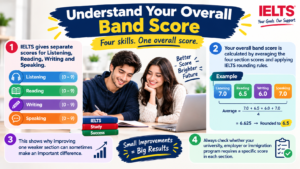
IELTS gives separate scores for Listening Reading Writing and Speaking.
Your overall band score is calculated by averaging the four section scores and applying IELTS rounding rules.
For example if your scores are 7.0 Listening 6.5 Reading 6.0 Writing and 7.0 Speaking the average is 6.625 which results in an overall Band 6.5.
This shows why improving one weaker section can sometimes make an important difference.
Always check whether your university employer or immigration program requires a specific score in each section.
IELTS 2026 Study Roadmap
Start by taking a practice test and identifying your current level.
Then focus on your weakest areas while continuing to practise all four skills.
During preparation work on Listening concentration Reading speed Writing organisation and Speaking fluency.
As your exam approaches add more timed exercises and full mock tests.
Finally review your common mistakes and avoid trying to learn everything during the final few days.
Final Thoughts
Improving your IELTS band score in 2026 is not about finding one secret trick. It is about understanding the test building your English skills and practising intelligently.
Set a realistic target and find out your current level. Focus on your weakest areas and learn from your mistakes.
Practise Listening and Reading under time pressure. Improve Writing through better organisation and grammar. Speak English regularly to build confidence and fluency.
Most importantly use reliable preparation materials and measure your progress by the mistakes you stop making.
With consistent practice and a clear strategy you can approach your IELTS 2026 exam with greater confidence and work toward the band score you need.