
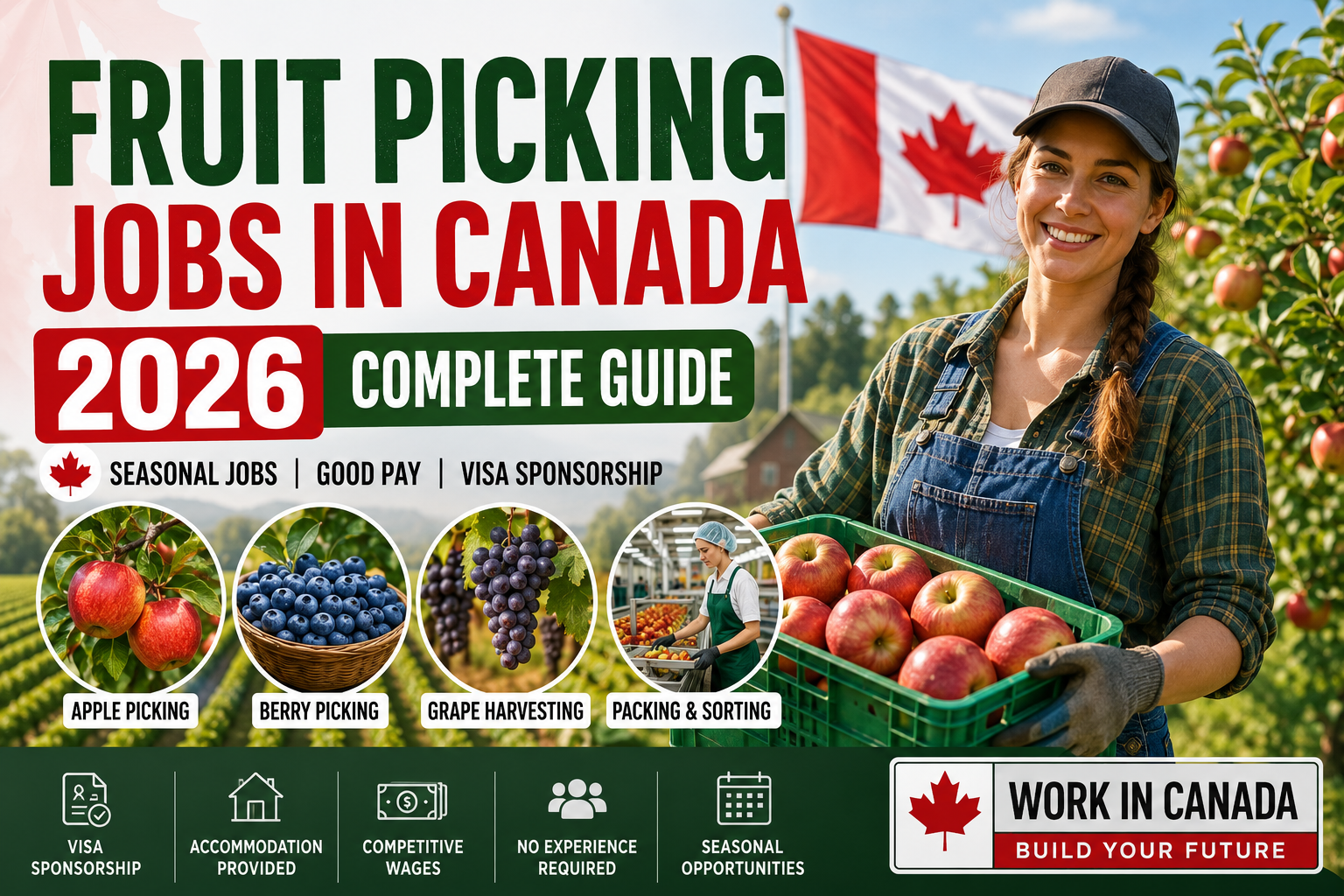
Fruit Picking Jobs in Canada 2026 can be an option for people interested in seasonal agricultural employment. Canadian farms regularly need workers for harvesting, sorting, packing and other crop-related activities. Depending on the season and employer the opportunities may be available in orchards, berry farms vineyards, greenhouses and the other agricultural operations.
For international applicants, however, getting a farm job is only one part of the process. Foreign nationals who need a Canadian work permit must receive the required authorization before starting employment. Depending on the position and immigration pathway, the Canadian employer may also need to complete an LMIA process.
This guide explains how fruit-picking jobs work, the main agricultural programs, common requirements, types of farm jobs, working conditions, wages, accommodation, transportation and the steps international applicants should understand before applying.
What Are Fruit Picking Jobs in Canada?
Fruit-picking jobs are part of Canada’s agriculture and primary food-production sector. These positions are often seasonal because farms need additional workers when crops are ready for harvesting.
The work can include much more than picking fruit. Workers may sort produce, remove damaged crops, carry skets or th containers, pack harvested products, clean work areas and help with other general farm activities.
The experience required depends on the employer and position. Some entry-level jobs may be accept applicants with little or no previous agricultural experience, while the other employers may prefer candidates who already understand harvesting, crop handling or the farm safety.
Common job titles include:
-
Fruit picker
-
Farm worker
-
Farm labourer
-
Agricultural worker
-
Harvesting worker
-
Orchard worker
-
Berry picker
-
General farm worker
-
Greenhouse worker
-
Fruit farm worker
-
Packing-house worker
Applicants should always read the complete job description because responsibilities can vary significantly between farms.
What Does “Visa Sponsorship” Mean?
The phrase visa sponsorship is the commonly used in the overseas job advertisements, but it can be misleading if the it is not explained properly.
A Canadian employer does not directly issue a Canadian visa to the a foreign worker. Instead, an employer may support a worker through the required employment and immigration process.
For an employer-specific work permit, the employer may need to obtain an LMIA. The Labour Market Impact Assessment process helps determine whether hiring a temporary foreign worker is the permitted under the applicable requirements.
After the employer completes the required steps, the worker can receive the documents needed to apply for the appropriate work permit.
A job offer alone does not give a foreign worker permission to the start working in Canada. If a work permit is required, the worker must obtain the necessary authorization before beginning employment.
This is particularly important when dealing with recruiters. Anyone saying that you can simply pay money to receive a guaranteed Canadian visa or LMIA should be treated with caution.
Main Canadian Agricultural Programs
Two important temporary foreign-worker routes connected with agricultural employment are the Seasonal Agricultural Worker Program and the Agricultural Stream.
These programs have different eligibility and recruitment rules, so applicants should not assume that they are interchangeable.
Seasonal Agricultural Worker Program
The Seasonal Agricultural Worker Program, known as SAWP, allows eligible Canadian agricultural employers to hire temporary foreign workers when Canadian citizens and permanent residents are unavailable.
SAWP is limited to citizens of participating countries. The current participating arrangements include Mexico and specified Caribbean countries, including countries such as Jamaica, Barbados, Trinidad and Tobago, Grenada, Dominica and Saint Lucia.
Fruit and vegetable production can be included under the program when the employment meets the applicable requirements for primary agriculture.
SAWP employment can be for a maximum of eight months between January 1 and December 15, subject to the program’s conditions.
An important point is that participating governments have a role in recruiting and selecting workers. Therefore, an applicant should not assume that directly contacting a Canadian farm automatically means they are applying through SAWP.
Agricultural Stream
The Agricultural Stream provides another route for Canadian employers to hire temporary foreign workers for eligible agricultural positions.
Fruits and vegetables can fall within the commodity sectors covered by the program when the work meets the applicable requirements for on-farm primary agriculture.
Unlike SAWP, the Agricultural Stream does not use exactly the same participating-country recruitment arrangement. Eligibility depends on the employer, position, worker and other program requirements.
The possible employment period can also differ. For example, eligible low-wage agricultural positions may have longer employment periods than positions covered by the seasonal SAWP arrangement.
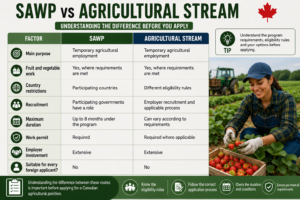
SAWP vs Agricultural Stream
| Factor | SAWP | Agricultural Stream |
| Main purpose | Temporary agricultural employment | Temporary agricultural employment |
| Fruit and vegetable work | Yes, where requirements are met | Yes, where requirements are met |
| Country restrictions | Participating countries | Different eligibility rules |
| Recruitment | Participating governments have a role | Employer recruitment and applicable process |
| Maximum duration | Up to 8 months under the program | Can vary according to requirements |
| Work permit | Required | Required where applicable |
| Employer involvement | Extensive | Extensive |
| Suitable for every foreign applicant? | No | No |
Understanding the difference between these routes is important before applying for a Canadian agricultural position.
Do Fruit Pickers Need an LMIA?
Some agricultural jobs may require an LMIA, while others may follow a different immigration pathway.
For an employer-specific work permit where an LMIA is required, the Canadian employer handles the relevant LMIA application. The foreign worker does not simply purchase an LMIA.
Agricultural LMIA applications can involve requirements related to recruitment, wages, accommodation, transportation and working conditions.
Applicants should therefore be cautious if a recruiter tells them that they personally need to buy an LMIA before an employer can hire them.
A legitimate employer should be able to explain the position, recruitment process and applicable work-permit pathway.
Who Can Apply for Fruit-Picking Jobs?
There is no single list of requirements that applies to every Canadian farm.
An employer may accept entry level workers with the limited agricultural experience while another may require previous harvesting or farm experience.
Common requirements may include:
-
Valid passport or travel document
-
Ability to perform physical work
-
Willingness to the work outdoors
-
Ability to the follow safety instructions
-
Reliability and punctuality
-
Ability to work as part of a team
-
Relevant agricultural or manual work experience where the required
-
Ability to satisfy the immigration requirements for the particular position
Previous farming experience can be helpful but the it should not be presented as mandatory for the every fruit picking job.
Experience in construction, landscaping, warehousing or other physical work may also provide useful transferable skills.
Can Applicants From Africa Apply?
Applicants from African countries should carefully check the specific immigration pathway attached to a job.
SAWP is restricted to citizens of participating countries, and African countries are not part of the current SAWP country list.
However, this does not mean that every Canadian agricultural job is unavailable to African applicants. Other temporary foreign-worker routes can have different eligibility requirements.
The important step is to identify the actual employer, job, recruitment process and work-permit pathway rather than relying only on the phrase “visa sponsorship.”
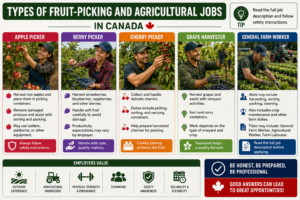
Types of Fruit-Picking and Agricultural Jobs
Apple Picker
Apple orchard workers may harvest ripe apples, place fruit into picking containers, remove damaged produce and assist with sorting and packing.
Depending on the farm, workers may also use ladders, platforms or other equipment. Safety instructions should always be followed.
Berry Picker
Berry farms may employ workers to harvest strawberries, blueberries, raspberries and other berries.
Because soft fruit can be easily damaged, workers usually need to handle produce carefully. Productivity expectations may also vary between employers.
Cherry Picker
Cherry harvesting involves collecting and the handling delicate fruit. Duties can include picking, sorting, carrying containers and the helping prepare harvested cherries for packing.
Grape Harvester
Grape-related agricultural positions may involve harvesting, sorting, carrying containers and assisting with other vineyard activities.
The exact work depends on the type of vineyard and the crop being produced.
General Farm Worker
Some vacancies combine harvesting with sorting, packing, cleaning, crop maintenance and other farm duties.
These jobs may be advertised under titles such as general farm worker, agricultural worker or farm labourer.
The job title alone does not the tell you everything about the position so applicants should read the full description.
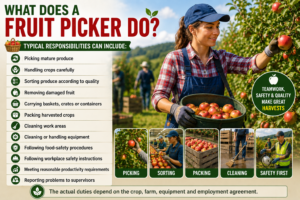
What Does a Fruit Picker Do?
Typical responsibilities can include:
-
Picking mature produce
-
Handling crops carefully
-
Sorting produce according to quality
-
Removing damaged fruit
-
Carrying baskets, crates or containers
-
Packing harvested crops
-
Cleaning work areas
-
Cleaning or handling equipment
-
Following food-safety procedures
-
Following workplace safety instructions
-
Meeting reasonable productivity requirements
-
Reporting problems to supervisors
The actual duties depend on the crop, farm, equipment and employment agreement.
Working Conditions You Should Expect
Fruit picking is generally physical work.
A normal day may involve standing for long periods, walking between crop rows, bending, reaching, lifting and performing repetitive tasks.
Outdoor conditions can also vary. Depending on the region and season, workers may experience sunlight, rain, cooler temperatures or changing weather conditions.
Harvest periods may include early starts and the changing schedules when permitted by the applicable employment standards.
People considering this type of work should understand these conditions before accepting an offer.
Fruit picking may suit someone looking for seasonal agricultural employment, but it may not be the suitable for the someone expecting an office-style working environment or theguaranteed year-round employment.
Where Are Fruit-Picking Jobs Available in the Canada?
Agricultural employment is available in several Canadian provinces, although crops and harvesting periods differ.
British Columbia
British Columbia has important agricultural and fruit-growing areas involving crops such as apples, cherries, berries and grapes.
Ontario
Ontario has significant fruit and tender-fruit production, including apples, grapes and berries.
Quebec
Quebec has agricultural operations involving apples, berries and other crops.
Nova Scotia
Nova Scotia has agricultural production that includes apples and berries.
New Brunswick
New Brunswick has farms producing berries and other agricultural crops.
Job availability changes throughout the year, so applicants should check current vacancies rather than assuming a particular province will always have openings.
Fruit-Picking Seasons in Canada
Harvest periods depend on the crop, location and weather.
| Crop | General Period | Common Work |
| Strawberries | Late spring to summer | Picking, sorting and packing |
| Cherries | Summer | Harvesting, sorting and packing |
| Blueberries | Summer | Picking, sorting and packing |
| Raspberries | Summer | Picking and handling |
| Apples | Late summer to fall | Picking, sorting and packing |
| Grapes | Late summer to fall | Harvesting and sorting |
These are general seasonal patterns rather than guaranteed hiring dates. Weather and crop conditions can affect the actual harvest period.
How Much Do Fruit Pickers Earn in Canada?
There is no single national salary for the all fruit picking workers.
Pay can depend on the province employer, crop, number of hours, wage structure, seasonal demand experience and the applicable employment standards.
Temporary foreign workers must receive the wages and benefits required under the applicable rules.
Before accepting an offer the applicants should carefully review is the employment agreement. Pay attention to the stated wage, expected working hours, deductions, benefits and contract period.
Do not judge an opportunity only by a headline salary. The complete employment terms are more important.
Accommodation and Transportation
Accommodation can be particularly important for overseas farm workers because many agricultural operations are located outside major cities.
Under the Agricultural Stream, employers have specific responsibilities concerning adequate, suitable and affordable housing. Rules can also cover transportation between employer-provided accommodation and the workplace.
Certain agricultural programs also include transportation requirements. Under the Agricultural Stream, employers must handle applicable transportation costs according to the program requirements.
SAWP workers have separate housing and transportation rules.
Applicants should not assume that every farm provides the same accommodation or travel benefits. Always check the written employment terms before travelling.
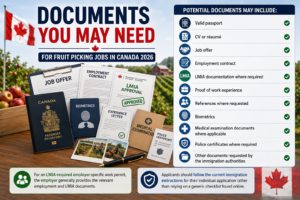
Documents You May Need
The exact document requirements depend on the worker and the work-permit application.
Potential documents may include:
-
Valid passport
-
CV or résumé
-
Job offer
-
Employment contract
-
LMIA documentation where required
-
Proof of the work experience
-
References where requested
-
Biometrics
-
Medical examination documents where applicable
-
Police certificates where the required
-
Other documents requested by the immigration authorities
For an LMIA-required employer-specific work permit, the employer generally provides the relevant employment and LMIA documents.
Applicants should follow the current immigration instructions for their individual application rather than relying on a generic checklist found online.
How to Find Legitimate Fruit-Picking Jobs in Canada
The Government of Canada’s Job Bank is an important starting point for people searching for agricultural employment.
Applicants can also check provincial agricultural employment resources, official farm websites, agricultural company career pages and established Canadian employment platforms.
Useful search terms include:
-
Fruit picker
-
Farm worker
-
Farm labourer
-
Harvesting worker
-
Agricultural worker
-
Orchard worker
-
Berry picker
-
General farm worker
-
Greenhouse worker
-
Fruit farm worker
Using several job titles can help applicants find positions that are not specifically advertised as “fruit picker.”
How to Search Job Bank
Start by searching relevant agricultural job titles on the Government of Canada’s Job Bank.
When you find a vacancy, review the employer name, location, wage, duties, posting date and application instructions.
Where available, check the LMIA information shown on the posting. Some Job Bank postings may indicate whether an employer’s LMIA application has been requested or approved.
However, finding a vacancy on Job Bank does not the automatically mean that the an applicant qualifies for a work permit.
Employment eligibility and immigration authorization are separate matters.
How to Prepare Your CV
A fruit-picking CV does not need to be unnecessarily long.
Include your name and contact information, a short professional summary, previous employment, relevant skills, education and languages.
If you have genuine experience in the farming construction warehousing, landscaping or the outdoor work explain the responsibilities you performed.
Useful transferable skills can include teamwork, punctuality, equipment handling, outdoor work and experience with physically demanding tasks.
Always provide truthful information. Do not add agricultural experience that you do not actually have.
How to Write a Strong Application
A tailored application can be more effective than sending exactly the same message to every farm.
Mention the specific position, your relevant experience and your availability.
If the employer asks about outdoor work, harvesting or physical duties, answer those questions directly.
International applicants should also clearly state their current situation. Do not claim that you are already authorized to work in Canada if you still need a work permit.
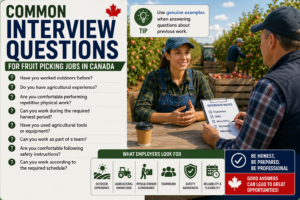
Common Interview Questions
A farm employer may ask questions such as:
-
Have you worked outdoors before?
-
Do you have agricultural experience?
-
Are you comfortable performing repetitive physical work?
-
Can you work during the required harvest period?
-
Have you used agricultural tools or equipment?
-
Can you work as part of a team?
-
Are you comfortable following safety instructions?
-
Can you work according to the required schedule?
Use genuine examples when answering questions about previous work.
How to Verify a Canadian Farm Employer
Before sending sensitive documents or accepting a job offer, research the employer.
Check the official company or farm website, business location, employer name, contact details and job advertisement.
Also review the crop, duties, wage, contract duration, accommodation and transportation information.
Be careful if a recruiter refuses to identify the actual employer or cannot provide basic information about the farm.
Do not rely solely on a WhatsApp profile, social-media page, company logo or photograph of a supposed employment contract.
Canada Fruit-Picking Job Scams to Avoid
International agricultural jobs can attract fraudulent recruiters because many people are interested in working in Canada.
Be particularly cautious if someone:
-
Demands money for an LMIA
-
Promises a guaranteed Canadian visa
-
Guarantees permanent residence
-
Charges a large job-reservation fee
-
Refuses to identify the employer
-
Sends an unexplained employment contract
-
Pressures you to transfer money immediately
-
Claims you can work before receiving authorization
-
Requests unusual payments through personal accounts
-
Refuses to provide verifiable business information
A legitimate opportunity should be assessed through the actual employer, written employment information and the applicable Canadian immigration process.
Your Rights as a Temporary Foreign Worker
Temporary foreign workers are protected by Canadian laws.
Agricultural employers must follow applicable rules concerning wages, workplace safety and employment conditions.
Employers also cannot simply take a worker’s identification documents.
Temporary employment does not mean that a worker gives up their legal protections. Workers should use official Canadian resources to understand their rights and available options if workplace problems occur.
Can Seasonal Fruit-Picking Work Lead to Permanent Residence?
A seasonal agricultural job does not automatically result in Canadian permanent residence.
Permanent-residence eligibility depends on the immigration program and whether the applicant meets its requirements.
Depending on the pathway, factors can include eligible work experience, occupation, language ability, education, Canadian work experience and provincial requirements.
Applicants should therefore be careful with anyone promising guaranteed permanent residence through an ordinary fruit-picking job.
If permanent residence is your long-term goal, check the current requirements of the specific federal or provincial immigration program that may apply to your circumstances.
Can Your Family Accompany You?
Family immigration rules are separate from the employment offer.
Whether a spouse or dependent child can accompany a temporary foreign worker depends on the worker’s circumstances and the immigration rules in effect at the time.
Applicants should not assume that every seasonal agricultural worker has identical options for bringing family members.
Current Canadian immigration guidance should be checked before making travel arrangements for relatives.
Step-by-Step: How to Apply From Outside Canada
Step 1: Find suitable vacancies
Search Job Bank, provincial agricultural resources and genuine farm websites.
Step 2: Verify the employer
Make sure the farm or agricultural business exists and that the vacancy is genuine.
Step 3: Read the complete job description
Check the crop location, duties, wage hours contract period, accommodation and the transportation information.
Step 4: Prepare your CV
Highlight genuine farming outdoor warehouse construction, landscaping or the other relevant experience.
Step 5: Complete the recruitment process
Follow the employer’s application and the interview instructions.
Step 6: Confirm the immigration pathway
Determine whether the position is connected with SAWP, the Agricultural Stream or another applicable work-permit route.
Step 7: Complete employer requirements
Where an LMIA is required, the employer handles the applicable LMIA process.
Step 8: Apply for the work permit
Once the required documents are available, follow the current Canadian immigration application instructions.
Step 9: Wait for authorization
Do not travel to Canada with the intention of beginning employment before receiving the required authorization.
Step 10: Review the employment terms
Before travelling, confirm your wage, location, contract duration, accommodation, transportation and other conditions.
What Should You Pack for Seasonal Farm Work?
After your employment and travel arrangements are properly confirmed, practical preparation becomes important.
Consider bringing weather-appropriate clothing, comfortable work clothes, suitable footwear, personal toiletries, identification documents, copies of employment documents and copies of immigration documents.
You should also keep important contact information available.
The exact equipment required depends on the employer. Avoid purchasing expensive specialized equipment unless the employer confirms that it is necessary.
Frequently Asked Questions
Can foreigners get fruit-picking jobs in Canada?
Yes. Foreign workers can be employed in eligible Canadian agricultural positions when the employer, worker and applicable immigration pathway meet the relevant requirements.
Can Africans apply for Canadian fruit-picking jobs?
Potentially. Eligibility depends on the job and immigration pathway. SAWP is limited to citizens of participating countries, so it should not be presented as an option for every African applicant.
Do fruit-picking jobs require an LMIA?
Some positions may require an LMIA, while the exact requirement depends on the applicable immigration pathway.
Do I have to pay for an LMIA?
No. A foreign worker should not be asked to purchase an LMIA. A recruiter demanding payment for an LMIA should be treated as a serious warning sign.
Do I need previous farming experience?
Not necessarily. Some entry-level positions may accept workers without previous farm experience, while other employers may require relevant experience.
How much does a fruit picker earn in Canada?
There is no single national wage. Earnings depend on the employer, location, crop, hours, wage structure and applicable employment rules.
Is accommodation provided?
It depends on the employer and agricultural program. Specific housing requirements can apply under agricultural programs.
Does the employer pay for transportation?
Certain agricultural programs include employer transportation obligations. The exact rules depend on the applicable program and employment arrangement.
Can I start working immediately after receiving a job offer?
No. A job offer by itself does not provide work authorization. If you need a work permit, you must receive the appropriate authorization before starting work.
Can fruit-picking work give me permanent residence?
Not automatically. Permanent residence is a separate immigration matter and requires qualification under an applicable program.
Can I change employers after arriving in Canada?
If you have an employer-specific work permit, you generally cannot simply begin working for another employer without obtaining the required authorization or following the applicable process.
Where can I find legitimate Canadian agricultural jobs?
The Government of Canada’s Job Bank is a useful starting point. Applicants can also check provincial agricultural employment resources and verified employer websites.
Final Checklist Before Accepting a Job
Before committing to an overseas agricultural position, make sure you know:
-
Who the actual Canadian employer is
-
Where the farm is located
-
What crop you will work with
-
What duties you will perform
-
What wage is offered
-
How many hours are expected
-
How long the contract lasts
-
Whether accommodation is provided
-
What accommodation deductions apply
-
What transportation is available
-
Which agricultural program applies
-
Whether an LMIA is required
-
Who handles the LMIA process
-
What employment documents you will receive
-
What work permit you need
-
Whether the information can be verified through official Canadian sources
If important information remains unclear, investigate the opportunity further before sending money or sensitive personal documents.
Final Thoughts
Fruit Picking Jobs in Canada 2026 can provide seasonal employment opportunities for people interested in agricultural work, but applicants should understand the difference between finding a job and obtaining permission to work.
Depending on the circumstances, foreign workers may be recruited through the Seasonal Agricultural Worker Program, Agricultural Stream or another applicable immigration route. Each pathway has its own requirements.
Before accepting an offer, verify the employer, read the complete job description, understand the wage and working conditions, and confirm the applicable work-permit process.
Most importantly, be cautious of anyone promising a guaranteed Canadian visa, LMIA or permanent residence in exchange for money.
A genuine Canadian agricultural opportunity should be evaluated through reliable employment information, the actual employer and the appropriate Canadian immigration process.