
Finding a job in Europe in 2026 is possible for international applicants, but the process starts with choosing the right opportunity for your profile, not simply choosing a country you like. Europe is not one single employment market. Each country has its own labour-market needs, salary requirements, language expectations, qualification rules, work-permit procedures and immigration policies.
A better approach is to the first understand your education age occupation, experience and realistic salary expectations. Then you can identify European countries and employers where your profile is actually competitive.
For many jobseekers, useful starting points include EURES, European Job Days, national employment portals and direct applications to employers. Depending on your qualifications and job offer, options such as employer-sponsored work permits or the EU Blue Card may also be relevant.
This guide explains how to approach the European job market in 2026, where to search what to the check before applying and how to avoid common mistakes and fraudulent job offers.
Start With Your Profile, Not a Country List
One of the most common mistakes international jobseekers make is choosing a country first and only later discovering that its salary threshold, language requirements or immigration rules make them ineligible.
Reverse that process.
Before searching for European jobs, write down four important facts:
-
Your highest degree and the year you earned it
-
Your age
-
Your occupation and professional experience
-
The realistic gross salary you could receive from an employer
Your occupation is particularly important. Some European countries experience shortages in specific professions, while other occupations may have more competition. A profession appearing on a shortage occupation list can sometimes improve your employment prospects, although being on such a list does not the automatically guarantee a job or visa.
Your qualifications and the experience should also match the position. An applicant with several years of relevant experience may have different opportunities from someone entering the workforce for the first time.
Salary matters too. A job may look attractive until you discover that the offered salary does not meet the requirements for a particular work-permit route. Therefore, salary should be evaluated together with the job, qualifications and immigration pathway.
Understand the European Labour Market
Europe offers employment opportunities across many industries, but demand varies by the country and occupation.
Some employers may have difficulty finding qualified workers in the particular sectors. These labour shortages can create opportunities for international applicants with relevant skills.
However, “Europe jobs” should not be treated as one category. A shortage in one country does not mean the same occupation is in shortage everywhere.
Before applying, research:
-
Current demand for your occupation
-
Required qualifications
-
Professional licensing requirements
-
Language expectations
-
Typical salary levels
-
Work-permit conditions
-
Whether employers recruit international workers
-
Whether your qualifications need recognition
This profile-first approach can prevent you from spending weeks applying for jobs that you are unlikely to qualify for.
Search for Jobs Through EURES
EURES is one of the most useful resources for people looking for employment opportunities across Europe. The network provides job-search support and information for people interested in working across European countries.
Jobseekers can use EURES-related services to explore vacancies and obtain information about living and working conditions, labour markets and employment opportunities.
Instead of searching randomly for “jobs in Europe,” use specific filters related to your profession, location and employment preferences.
For example, you might search for:
-
Your exact job title
-
Your profession plus a country
-
Your profession plus a city or region
-
Full-time positions
-
Permanent contracts
-
Positions matching your qualifications
-
Jobs suitable for international applicants
EURES can be especially useful because it is helps connect jobseekers with employment opportunities across participating European labour markets.
Explore European Job Days in 2026
European Job Days are another useful resource for the people looking for European employment opportunities.
These events can connect jobseekers with employers and provide opportunities to learn about recruitment requirements. Depending on the event, applicants may be able to the communicate with employers without travelling to Europe first.
For an international jobseeker, this can be the more efficient than sending hundreds of applications without knowing whether employers recruit from abroad.
When participating in a European Job Day, prepare your CV carefully and research participating employers before the event. Know what type of job you want and be ready to the explain your qualifications, experience and the availability.
A focused application is usually more useful than a generic message sent to every employer.
Apply Directly to European Employers
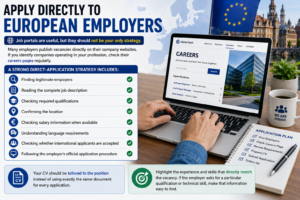
Job portals are useful, but they should not be your only strategy.
Many employers publish vacancies directly on their company websites. If you identify companies operating in your profession, check their careers pages regularly.
A strong direct-application strategy includes:
-
Finding legitimate employers
-
Reading the complete job description
-
Checking required qualifications
-
Confirming the location
-
Checking salary information when available
-
Understanding language requirements
-
Checking whether international applicants are accepted
-
Following the employer’s official application procedure
Your CV should be tailored to the position instead of using exactly the same document for every application.
Highlight the experience and skills that directly match the vacancy. If the employer asks for a particular qualification or technical skill, make that information easy to find.
Prepare a Strong CV for European Jobs
Your CV is often the first major screening point.
A good European job application should be clear, accurate and easy to understand. Avoid unnecessary information and the do not make claims that you cannot support.
Include relevant:
-
Education
-
Work experience
-
Professional skills
-
Technical skills
-
Certifications
-
Language abilities
-
Achievements
-
Contact information
Depending on the job and country, a Europass CV may also be useful. However, always check whether the employer specifies a particular CV format.
Most importantly, make sure the information on your CV matches your actual experience. False qualifications or the exaggerated experience can damage your application and create immigration problems later.
Check Qualification Recognition
A degree earned outside Europe may not automatically have the same professional status in every country or occupation.
This is particularly important for regulated professions. Certain careers can require formal recognition, registration, licensing or additional examinations before you can legally work.
Before accepting a job offer, determine whether your profession is regulated in the destination country.
For example, the process for a regulated professional may be very different from the process for an ordinary non-regulated occupation.
Research the relevant national authority and determine:
-
Whether your qualification is recognised
-
Whether documents need translation
-
Whether certification is required
-
Whether professional registration is necessary
-
Whether additional training is required
Doing this early can save significant time.
Consider Language Requirements
Language can be one of the biggest factors affecting your chances of finding work in Europe.
Some international companies operate primarily in the English, while other positions require the local language.
Do not assume that an English-language job advertisement means every job in that country is available in the English.
Read the vacancy carefully. Employers may specify requirements such as:
-
English proficiency
-
Local-language proficiency
-
Customer communication skills
-
Professional terminology
-
Minimum language level
If your target profession requires communication with local customers, patients, colleagues or the government authorities, language skills may be particularly important.
Learning the local language can also expand the number of jobs available to you.
Understand Salary and Work-Permit Requirements
A realistic salary estimate is one of the four key pieces of information you should identify before choosing a country.
Do not focus only on the advertised gross salary. Consider whether the position meets the requirements of the immigration route you intend to use.
Salary thresholds can vary according to the country, visa category, occupation and applicant circumstances. They can also change over time.
This is why a 2026 applicant should verify current requirements rather than relying on an old article or the social-media post.
Look at:
Job offer → Gross salary → Qualification → Occupation → Immigration route
These factors should be considered together.
A high salary does not automatically mean a successful visa application, and a shortage occupation does not automatically guarantee approval.
Understand Work Visa and Work Permit Rules
There is no single universal “Europe work visa” that allows every foreign worker to work anywhere in Europe.
Each country has its own immigration system.
Depending on the destination and your circumstances, you may need:
-
A valid employment contract
-
Employer sponsorship or support
-
A work permit
-
Proof of qualifications
-
Proof of professional experience
-
Salary meeting applicable requirements
-
Health insurance or other documentation
-
A valid passport and supporting documents
Always check the immigration authority of the specific country before making financial commitments.
A genuine job offer is not the same thing as guaranteed visa approval.

Consider the EU Blue Card
Highly qualified international workers may also want to investigate the EU Blue Card.
The EU Blue Card is designed for highly qualified non-EU workers who meet the applicable conditions. Requirements can include an eligible employment contract or job offer, appropriate professional qualifications or recognised professional experience and a salary meeting the applicable threshold.
The exact rules vary and can change, so applicants should check the current official requirements for the country where they plan to work.
For qualified professionals, the EU Blue Card can therefore be an important search term when the researching European employment and immigration options.
Searches such as EU Blue Card 2026, EU Blue Card requirements, EU Blue Card jobs and high-skilled jobs in the Europe can help applicants find relevant official information.
How to Find Visa Sponsorship Jobs in Europe
Many international applicants specifically search for visa sponsorship jobs in Europe.
However, you should be careful with this phrase because not every employer is willing or legally able to sponsor an international worker.
When reviewing a vacancy, look for clear information about international recruitment, relocation support or work-permit assistance.
If sponsorship is not mentioned, you can contact the employer through an official channel and ask whether they consider candidates who require work authorisation.
Avoid paying someone simply because they claim they can “guarantee” European visa sponsorship.
A legitimate employer will normally provide clear information about the job, employment conditions and recruitment process.
Avoid Fake European Job Offers
International jobseekers are frequent targets of recruitment scams.
Be cautious if someone promises:
-
Guaranteed European employment
-
Guaranteed visa approval
-
Extremely high salary for the little experience
-
Immediate employment without an interview
-
A visa in exchange for the a large upfront payment
-
A job offer using only the a personal email address
-
A fake-looking company website
-
Requests for sensitive documents before proper verification
Verify the employer independently.
Visit the company’s official website, check its contact details and compare the vacancy with the information on the legitimate employment platforms.
Never assume that a professional-looking job offer is genuine simply because it contains a company logo or an employment contract.
Use a Country-by-Country Strategy
Once you understand your own profile, create a shortlist of countries rather than applying everywhere.
For each country, compare:
|
What to Check |
| Occupation | Is your profession in demand? |
| Salary | What is the realistic gross salary? |
| Qualifications | Are your credentials accepted? |
| Language | What level is required? |
| Work permit | What route applies? |
| Employer | Does the company recruit internationally? |
| Cost of living | Can the salary support your plans? |
| Long-term options | What legal pathways may be available? |
This comparison makes your job search more realistic.
The best European country for one applicant may be completely unsuitable for another. Your occupation, qualifications, language skills, salary and experience all matter.
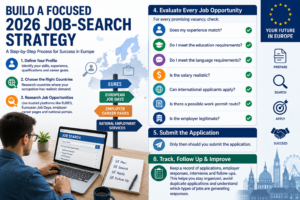
Build a Focused 2026 Job-Search Strategy
A successful job search is easier when you treat it like a process.
Start by defining your professional profile. Then identify countries where your occupation has realistic demand.
Next, research vacancies through EURES, European Job Days, employer career pages and the reliable national employment services.
For every promising vacancy, check:
-
Does my experience match?
-
Do I meet the education requirements?
-
Do I meet the language requirements?
-
Is the salary realistic?
-
Can international applicants apply?
-
Is there a possible work-permit route?
-
Is the employer legitimate?
Only then should you submit the application.
Keep a record of applications, employer responses, interviews and follow-ups. This prevents you from repeatedly applying to the same company and helps you understand which types of jobs are generating responses.
What International Applicants Should Remember
Finding work in Europe in 2026 is not simply about finding a website with thousands of vacancies. It is about matching your profile with a real labour-market opportunity and a legal immigration pathway.
Your degree matters. Your age may matter for some routes and circumstances. Your occupation matters. Your experience matters. Your language ability matters. Your realistic salary matters.
Most importantly, immigration rules matter.
Start with your own profile, identify suitable occupations and the countries, then search for genuine employers.
Use established resources such as the EURES and European Job Days, but also investigate companies directly. Check qualification-recognition requirements and understand is the relevant work-permit rules before accepting an offer.
Do not rely on promises from unofficial agents or social-media accounts claiming to guarantee jobs or the visas.
Final Thoughts
The strongest approach to finding a job in Europe in 2026 is profile first, country second.
Instead of asking only, “Which European country is best?”, ask:
Which European country has a realistic opportunity for someone with my education, occupation, experience, language skills and salary expectations?
That question leads to a much more effective job search.
Use your profile to narrow the market. Check shortage occupations where relevant. Search EURES and European Job Days. Apply directly to legitimate employers. Prepare a targeted CV. Verify qualification and language requirements. Then investigate the work-permit or EU Blue Card route that may apply to your circumstances.
Most importantly, verify current requirements through official government and European sources before making decisions. Employment and immigration rules can change, and information that was correct in an earlier year may no longer apply in 2026.
A careful, evidence-based and profile-focused strategy gives international applicants a much better starting point than simply sending applications to every country in Europe.